
Why Natural Collagen Hip Dysplasia Support Matters for Your Dog
Natural collagen hip dysplasia support works by replenishing the structural proteins that hold your dog’s hip joint together, helping to reduce pain, improve mobility and slow cartilage breakdown.
Quick answer: How collagen supports dogs with hip dysplasia
| What collagen does | Why it matters for hip dysplasia |
|---|---|
| Rebuilds cartilage and connective tissue | Slows joint degeneration caused by abnormal hip socket formation |
| Strengthens the hip joint capsule | Reduces laxity (looseness) that leads to wear and pain |
| Supports ligament and tendon repair | Helps stabilise the hip joint during movement |
| Lubricates the joint | Reduces friction and discomfort during daily activity |
| Stimulates chondrocytes | Encourages the body to produce its own proteoglycans and collagen |
Hip dysplasia is one of the most common inherited conditions in dogs. It causes the hip socket to form abnormally, leading to joint instability, pain and eventually arthritis. Yet despite decades of selective breeding programmes, the condition has not declined. In Germany, the incidence in German Shepherds remains at 7% despite strict kennel club restrictions. More striking still, over two thirds of dysplastic puppies in one study came from parents with normal hips.
Genetics is clearly only part of the picture.
Collagen is the protein that gives joints, tendons and ligaments their strength and elasticity. It makes up between 70 and 90% of the connective tissues supporting your dog’s hips. When collagen levels drop due to ageing, poor diet or other factors, joint integrity suffers. For dogs already predisposed to hip dysplasia, that decline can accelerate significantly.
This guide explains how natural collagen supports hip health, what the science says and how to use it alongside a broader care plan.
I’m Sharon Milani, Director of SmartPack PTY Ltd and co-founder of NutriFlex®, South Africa’s first certified human-grade pet supplement range, with experience formulating collagen-based joint solutions that provide natural collagen hip dysplasia support for dogs across all life stages. My work sits at the intersection of functional nutrition and veterinary science, and everything I share here is grounded in that foundation.
Understanding Canine Hip Dysplasia and the Role of Collagen
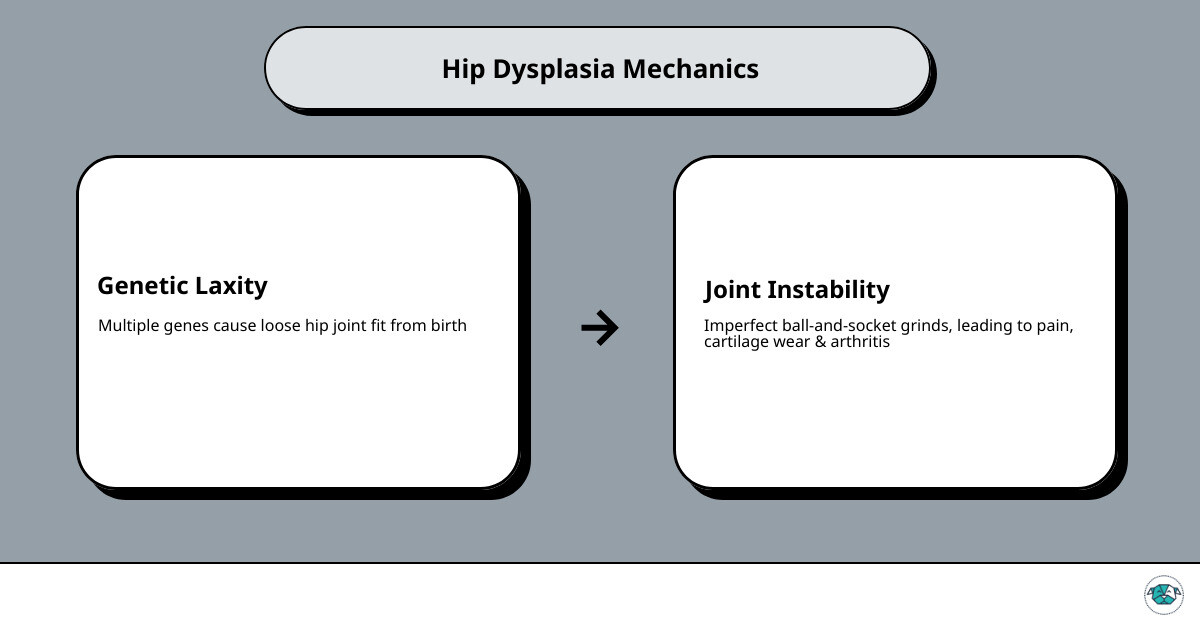
To understand why natural collagen hip dysplasia support is so effective, we first need to look at what is happening inside the joint. Canine hip dysplasia is a developmental condition where the “ball and socket” of the hip joint do not fit together perfectly. Instead of sliding smoothly, they rub and grind.
While genetics plays a central role, as dogs can pass the condition to their offspring, hip dysplasia is a polygenic disease. This means it is caused by the combined action of multiple genes alongside environmental factors like diet and lifestyle. Puppies with a genetic predisposition are often born with seemingly normal hips, but structural changes begin within just a few weeks of birth.
The primary issue is joint laxity (looseness). When the ligaments and joint capsule are not strong enough to hold the femoral head tightly in the acetabulum (the socket), the resulting instability damages the articular cartilage. This cartilage relies on a healthy supply of synovial fluid for lubrication and a dense matrix of collagen for structural integrity. Without these, the joint begins a downward spiral into osteoarthritis. For many owners, seeing a Labrador Hip Dysplasia Recovery plan in action highlights how critical early intervention is.
How natural collagen hip dysplasia support works
Collagen is not just a single protein; it is a family of proteins with different roles. In the hip joint capsule, Type I and Type III collagen are the major players. Type I collagen is particularly important because it makes up roughly 83% of the collagen present in the hip capsule, providing the high mechanical strength needed to keep the joint stable.
When we provide natural collagen hip dysplasia support, we are giving the body the specific amino acids required to maintain these tensile fibres. This helps:
- Strengthen the Joint Capsule: By supporting the production of Type I collagen, we help tighten the “sleeve” around the joint, reducing the laxity that causes damage.
- Repair Ligaments: Ligaments are essentially bundles of collagen. Supplementation provides the building blocks for self-repair.
- Improve Elasticity: Type III collagen provides compliance and elasticity, allowing the joint to absorb shock during activity without tearing.
Identifying symptoms across different life stages
Recognising the signs of hip dysplasia early is vital for successful management. The Morris Animal Foundation notes that symptoms can be divided into juvenile and mature onset.
Juvenile Onset (Under 18 months):
- Bunny Hopping: Using both back legs together when running.
- Joint Laxity: A vet may feel looseness during a physical exam.
- Difficulty Rising: Taking longer to get up from a nap.
- Lameness: Intermittent limping that may worsen after play.
Mature Onset (Over 18 months):
- Muscle Atrophy: Noticeable loss of muscle mass in the hindquarters.
- Stiffness: Especially in the mornings or after resting.
- Reluctance to Jump: Avoiding stairs or the car.
- Grating Sound: A clicking or grinding noise (crepitus) during movement.
The Science of Natural Collagen Hip Dysplasia Support
The effectiveness of collagen is not just anecdotal; it is rooted in how bioactive peptides interact with the body. When a dog consumes high quality hydrolyzed collagen, the peptides are absorbed into the bloodstream and travel to the joint tissues. Here, they stimulate chondrocytes (cartilage cells) to produce more proteoglycans and Type II collagen.
This process essentially “reboots” the extracellular matrix, the jelly-like substance that cushions the joints. By increasing the density of this matrix, we improve the joint’s ability to handle weight and movement. You can find more info about collagen benefits that detail how this structural support translates to better mobility.
Comparison of Collagen Types for Joint Support
| Feature | Hydrolyzed Collagen (Type I & III) | Undenatured Type II Collagen (UC-II) |
|---|---|---|
| Primary Source | Bovine or Marine skins/hides | Chicken sternum cartilage |
| Mechanism | Provides building blocks for tissue repair | Oral tolerance (modulates immune response) |
| Main Benefit | Strengthens ligaments, tendons and capsule | Reduces inflammation and cartilage breakdown |
| Best For | Overall structural integrity and recovery | Specific inflammatory joint conditions |
Environmental factors and collagen autoimmunity
One of the most provocative areas of canine health research involves the link between environmental triggers and joint disease. A 1999 study from Purdue University suggested a connection between vaccination and the development of autoantibodies to a dog’s own collagen.
The researchers found that vaccinated puppies developed autoantibodies to several types of collagen. This means the immune system began attacking the very proteins meant to hold the joints together. While vaccines are essential for preventing infectious diseases, this study highlights why “over-vaccination” can be a concern for joint health. If a dog’s immune system is attacking its collagen, the structural integrity of the hip joint is compromised from the inside out, making them even more susceptible to the mechanical stresses of hip dysplasia.
Early warning signs and natural collagen hip dysplasia support
Prevention is always better than cure, especially for large and giant breeds like German Shepherds, Rottweilers and Labradors. We recommend starting natural collagen hip dysplasia support as early as 18 months for at-risk breeds, even if they show no symptoms.
At this “milestone” age, the growth plates have usually closed, but the joints are still highly adaptable. Providing extra collagen at this stage helps maintain optimal joint lubrication and ensures the connective tissues are as strong as possible as the dog reaches full physical maturity. Owners looking for natural ways to manage hip dysplasia in dogs often find that starting early prevents the “silent” deterioration that leads to pain later in life.
Comprehensive Management: Diet, Exercise and Supplements
Managing hip dysplasia requires a holistic approach. Collagen is a powerful tool, but it works best when paired with proper lifestyle choices.

Weight Management and Exercise
In South Africa, our warm climate allows for year-round outdoor activity, but we must be careful with how we exercise dysplastic dogs.
- Low-Impact Exercise: Swimming is the gold standard. It builds muscle mass to support the hips without the jarring impact of running on hard surfaces.
- Weight Control: This is the most critical factor. Every extra kilogram puts immense pressure on a loose hip joint. Keeping your dog lean can significantly reduce pain levels without the need for medication.
- Controlled Walks: Short, frequent walks on soft grass are better than one long trek on pavement.
Synergistic nutrients for hip health
Collagen performs best when it has “teammates” in the diet. For advanced support, look for advanced collagen powder for dogs and cats that combines collagen with other functional ingredients:
- Omega-3 Fatty Acids: Found in high quality fish oil, these reduce inflammation. A recommended dose is roughly 5 ml (1 teaspoon) per 9 kg of ideal body weight.
- Green Lipped Mussel: A “miracle from the sea” that provides a natural source of glucosamine and chondroitin. The therapeutic dose is roughly 77 mg per kg of body weight.
- MSM (Methylsulfonylmethane): A natural sulphur compound that helps improve joint flexibility and reduces swelling.
- Glucosamine and Chondroitin: These are the classic “building blocks” that help maintain cartilage thickness.
For many dogs, a comprehensive dog joint supplement that includes these nutrients alongside collagen provides the most noticeable relief.
Safe introduction and dosage guidelines
When introducing natural collagen hip dysplasia support, slow and steady wins the race. While collagen is a natural food-based protein, any sudden change in diet can cause mild digestive upset in sensitive dogs.
- Week 1: Start with a quarter of the recommended daily dose mixed into their usual food.
- Week 2: Increase to half the dose.
- Week 3: Move to the full therapeutic dose.
A general guideline for collagen is roughly 5 grams (about one heaped teaspoon) per serving for a medium-sized dog. However, always check the specific gram weight on your product label. For more detailed advice, you can read collagen for dogs what you need to know.
Frequently Asked Questions about Natural Collagen Hip Dysplasia Support
How long does it take to see results from collagen?
Most owners begin to see improvements in mobility and a reduction in stiffness within 4 to 8 weeks of consistent daily supplementation. You might notice your dog is more willing to get up in the morning or has a bit more “bounce” during their afternoon walk. Because collagen works by repairing tissue, the results are cumulative rather than instant like a painkiller.
What is the recommended dosage for dogs?
Dosage should always be based on the dog’s weight and the severity of their condition. A standard maintenance dose for a healthy dog is often around 2.5 grams to 5 grams daily. For a dog struggling with active hip dysplasia, a therapeutic dose (often double the maintenance dose) may be required for the first few months to kickstart the repair process.
Can collagen prevent hip dysplasia in puppies?
While collagen cannot change a dog’s genetic code, it can provide the best possible environment for skeletal development. By ensuring a puppy has all the amino acids necessary for strong ligaments and tendons, you may help reduce the severity of joint laxity as they grow. Early intervention is especially important for giant breeds that grow rapidly between 4 and 10 months of age.
Conclusion
At NutriFlex®, we believe that every dog deserves to live a life free from the constraints of joint pain. Our mission is to provide South African pet owners with science-aligned, nutrition-first solutions that actually work.
Our collagen-based supplements are produced in a certified human-grade facility right here in Cape Town. We prioritise functional ingredients that support the body’s natural repair mechanisms, ensuring your pet gets the highest quality natural collagen hip dysplasia support available. Whether you are looking for a best joint supplement recommendation or are ready to start your dog on a new path to mobility, we are here to help.
By combining premium supplementation with weight management and low-impact exercise, you can help your dog get their bounce back and enjoy many more happy years by your side.