

Red paws.
Yeasty ears.
Constant licking.
Head shaking.
That unmistakable smell.
You treat it. It settles down.
Then it comes back.
When that cycle keeps repeating, one question is worth asking: why do we keep treating the yeast while the food in the bowl never changes?
At NutriFlex®, we don’t believe food should be treated as irrelevant simply because the problem appears on the skin. When a dog is stuck in a cycle of inflammation, itching and recurring yeast, we see very little logic in building a nutritional reset around an ultra-processed dry pellet.
Key takeaways
- The yeast on an itchy dog’s skin usually lives there already. It overgrows when inflammation and a damaged skin barrier give it room.
- Kibble and fresh food can meet the same nutrient standards and still behave very differently in the body. A 2026 crossover study found different glucose, hormone and gut microbiome responses in the same dogs.
- High-heat processing changes food. Kibble carries more heat-damaged lysine than fresh food. Fresh-fed senior dogs also had lower circulating AGEs over a year.
- Diet shapes the gut. In one study it also shaped the skin’s microbial life.
- Changing the food is optional in the NutriFlex® Skin Reset. We recommend it because we believe in species-appropriate diets. It can also speed up the reset.
Yeast is usually not the real starting point

The yeast most commonly associated with canine skin and ear problems is Malassezia pachydermatis.
Malassezia isn’t necessarily something your dog suddenly catches. It commonly lives on canine skin.
The problem begins when conditions change enough for that yeast population to proliferate. Inflammation, allergies, impaired skin-barrier function, increased oil production, moisture, hormonal disorders and other underlying problems can all create an environment in which Malassezia flourishes. For the signs, the triggers and the gut side of the story, read our guide on why yeast in dogs keeps coming back.
This is why some dogs get caught in a repeating cycle:
Inflammation
↓
damaged skin barrier
↓
yeast proliferation
↓
more inflammation
↓
itching, licking and scratching
↓
further barrier damage
↓
more opportunity for yeast
Treating the yeast can reduce the organism temporarily. But if the environment that allowed it to overgrow hasn’t changed, recurrence shouldn’t be surprising.
So the bigger question is not simply: how do we kill the yeast?
It is: why does this dog’s body keep creating an environment in which yeast thrives?
That brings us directly to diet.
Kibble is not simply fresh food with the water removed
Dry dog food is an industrially manufactured product. Ingredients are ground, mixed, heated, pressurised and commonly extruded before being formed into pellets and dried for shelf stability.
This manufacturing model has enormous practical advantages. Kibble is:
- cheap to transport
- shelf-stable
- convenient
- easy to portion
- easy to store
- highly scalable
But convenience and biological equivalence are not the same thing.
A growing body of research shows that minimally processed food and extruded kibble can produce distinctly different responses inside the dog, even when both meet accepted nutritional requirements.
In a 2026 randomised crossover study from the University of Sydney, 24 pet dogs were fed both an extruded kibble and a minimally processed, mildly cooked diet for two weeks each. Compared with the kibble, the minimally processed food produced:
- a lower and later post-meal glucose peak
- different gastrointestinal hormone responses
- greater gut microbial diversity
- clear differences in microbiome composition
Because every dog ate both foods, the differences came from the food rather than from the dogs.
That matters. Two foods can both be labelled “complete and balanced” while producing very different biological effects.
Nutritional adequacy and biological equivalence are not the same thing.
Processing changes food
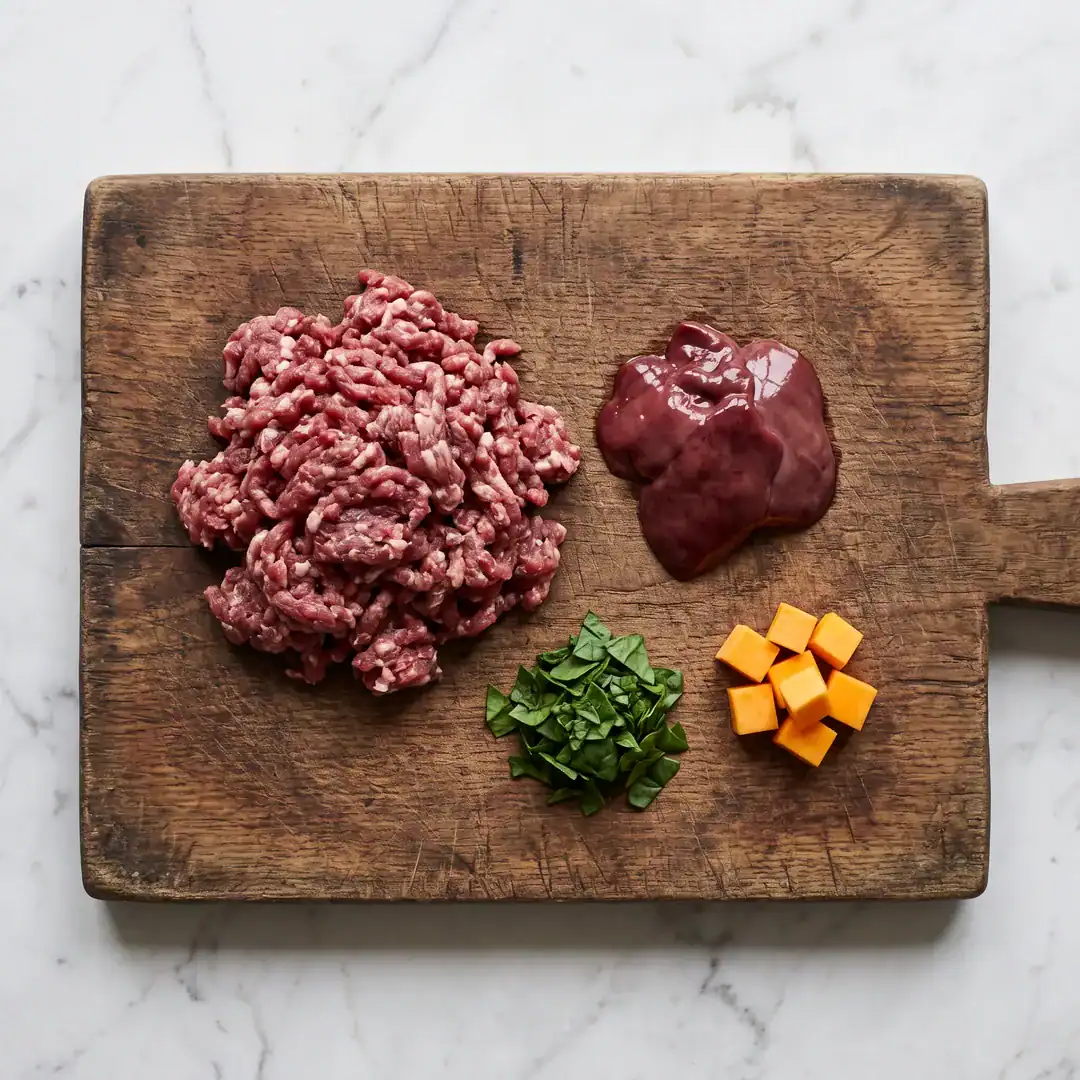
Food processing isn’t neutral. Heat and extrusion alter the physical and chemical structure of food. They change:
- starch gelatinisation
- protein structure
- digestibility
- nutrient availability
- oxidation
- microbial interactions
- the formation of processing compounds
High-temperature cooking can also create Maillard reaction products and advanced glycation end products, commonly called AGEs. These compounds form when sugars react with proteins or fats.
A recent analysis of commercial dog foods in the Journal of Animal Physiology and Animal Nutrition measured these processing compounds across food formats. Fresh foods held more than twice as much lysine as kibble (56 g versus 23 g per kilogram of dry matter), with far less of it blocked by heat damage. Canned food carried the highest levels of heat-created compounds of all.
Lysine is an essential amino acid. Once it is bound up in a Maillard reaction, the body can no longer use it. That is direct evidence that processing can materially change nutrient availability.
So when someone says, “It doesn’t matter how the food was made as long as the label says complete and balanced,” that is simply too crude. How a food was manufactured can affect what the body actually encounters metabolically.
Glycation matters

Advanced glycation end products deserve particular attention.
AGEs can accumulate in tissues and interact with receptors known as RAGE. That interaction is associated with:
- oxidative stress
- inflammatory signalling
- tissue stiffening
- altered protein function
- age-related cellular damage
In dogs, AGE accumulation has been documented in ageing tissues, including the nervous system. Experimental canine research has also shown that increasing AGE accumulation in cartilage can worsen osteoarthritis. The broader ageing literature associates excessive AGE accumulation with progressive tissue deterioration.
That doesn’t mean kibble = shorter life. That would be too simplistic. But it does mean there is good reason to take repeated AGE exposure seriously when thinking about long-term health.
There is now direct dietary evidence in dogs too. In a year-long study of senior dogs published in Metabolites in 2025, researchers compared dogs eating extruded kibble with dogs fed fresh human-grade food. The fresh-fed dogs had lower circulating advanced glycation end products, along with substantial metabolic differences that appeared within the first month and held for the full year.
That should make us ask an uncomfortable question: if one food format repeatedly exposes the body to a different glycation and metabolic profile, why should processing intensity be dismissed as irrelevant?
Ageing is partly a story of cumulative molecular damage. What a dog eats every single day for ten or fifteen years matters.
Dogs can digest starch. That doesn’t mean they need a starch-heavy diet.
One of the standard defences of kibble is that domestic dogs have evolved a greater ability to digest starch than wolves.
That is true. But it is often used to make a much bigger claim than the evidence supports.
Being able to digest starch does not mean a dog needs a starch-heavy diet. Dogs require:
- essential amino acids
- essential fatty acids
- vitamins
- minerals
- adequate energy
- appropriate micronutrients
They have no established dietary requirement for carbohydrate in the way they require protein-derived amino acids and essential fats.
Starch is, however, very useful technologically. It helps manufacture an extruded pellet and hold it together. That may be useful for the factory. It does not automatically make a starch-heavy pellet the obvious biological default for every dog.
Does carbohydrate directly feed the yeast on the skin?
You will often read: kibble contains carbohydrates → carbohydrates become sugar → sugar feeds yeast.
When it comes to yeast in the gut, that holds: the sugars and starches in the bowl reach it directly. On the skin the biology is more complicated.
There is no good evidence that starch from a dog’s meal simply travels through the body and directly feeds the Malassezia growing between their toes or inside their ears. Malassezia is also a lipophilic organism, meaning its biology is closely tied to lipids.
So for the skin we do not need to rely on the simplistic “carbs feed yeast” argument. There are stronger reasons to question a highly processed, carbohydrate-heavy diet in a chronically itchy dog.
The more credible pathway is indirect:
Diet
↓
gut microbiome and metabolic response
↓
immune and inflammatory signalling
↓
skin-barrier disruption
↓
altered skin environment
↓
opportunity for yeast to proliferate
↓
more inflammation
That is a much more realistic model of what may be happening.
What happens in the gut can affect the skin

Diet has a profound effect on the gut microbiome. And the gut is deeply involved in:
- immune regulation
- inflammatory signalling
- microbial metabolite production
- nutrient processing
- barrier function
Research comparing fresh, raw and kibble-fed dogs consistently shows differences in gut microbial populations and microbial metabolites.
A 2024 study in Frontiers in Veterinary Science fed 55 healthy dogs either a raw meat-based diet or kibble for 28 days. The researchers found significant differences in:
- microbial diversity
- microbiome composition
- serum metabolites
- local intestinal immune markers
Another feeding study, published in Animals in 2022, found that switching between fresh food and dry food changed not just the gut but the skin microbiome. When the dogs were eating fresh food, their skin carried a more diverse microbial population with a measurably different bacterial composition than during the month they ate dry food. It was a small study of eight healthy dogs, but its direction is clear.
What goes into the bowl can influence microbial life far beyond the gut. Diet and skin are not separate systems.
Food reactions often show up on the skin

Another mistake is to assume that food sensitivity should cause vomiting or diarrhoea. Often it doesn’t.
Adverse food reactions in dogs frequently show up on the skin. Commonly affected areas include:
- paws
- ears
- face
- groin
- underside of the body
Those are exactly the areas many pet parents describe as “yeasty”. If you suspect something specific in the bowl, our article on common food triggers for skin health covers the usual suspects.
A food-driven inflammatory response can weaken the skin barrier and change the local environment. An inflamed skin environment gives organisms such as Malassezia an opportunity to proliferate.
So sometimes the sequence may be:
something in the diet drives inflammation
↓
the skin barrier becomes compromised
↓
yeast proliferates
↓
yeast adds more inflammation
↓
the dog becomes even itchier
The yeast is real. But it may not be the first domino.
Then there is the ingredient problem
Many commercial dry foods have a surprisingly complex ingredient profile. A single bag may contain:
- several animal proteins
- rendered meals
- starches
- legumes
- plant proteins
- fats
- flavourings
- fibres
- vitamin and mineral premixes
- preservatives or processing aids
Then the dog gets biscuits. Chews. Treats. Flavoured medications.
Suddenly they are being exposed to dozens of different food components every day. And then we try to work out which one might be driving inflammation.
That is not a clean experiment.
Why we suggest stepping away from kibble during the Skin Reset

We believe in species-appropriate diets. Some dogs simply do not do well on kibble. When we are trying to understand a chronically itchy, yeasty dog, we also want fewer variables.
That means stripping the diet back:
One complete food.
One main protein.
A short, transparent ingredient list.
No biscuits.
No flavoured chews.
No unnecessary extras.
Where practical, we favour a complete, balanced fresh or properly formulated raw food built on a protein the dog has not been repeatedly exposed to. Raw is one option. A properly formulated, gently cooked fresh diet works too.
Not because fresh food magically kills yeast.
Not because raw food is a treatment.
And not because one meal changes the skin overnight.
We do it because it removes much of the nutritional noise. It gives you a cleaner baseline. And it can speed up the reset by taking an ultra-processed, starch-dependent food out of the picture while the gut and skin are given the chance to settle.
The bowl chapter is the longest part of our free Skin Reset guide, with what to feed, what to cut and what to expect week by week.
Why fresh food?
Because fresh food is fundamentally different from extruded food. Not philosophically. Biologically.
Studies comparing minimally processed or raw diets with kibble have shown differences in:
- digestibility
- post-meal glucose response
- gastrointestinal hormones
- microbial diversity
- microbial metabolites
- circulating metabolites
- the skin microbiome
- nutrient availability
- glycation-related compounds
That does not prove every fresh-fed dog will be healthier than every kibble-fed dog.
It does show something more important: food format matters. Processing matters. Ingredient complexity matters. Metabolic response matters.
In a dog already showing chronic skin inflammation, those differences become highly relevant.
“Complete and balanced” is not the whole story
This is where pet nutrition often becomes intellectually lazy.
A food can meet recognised nutrient standards and still differ dramatically in:
- ingredient quality
- degree of processing
- starch content
- oxidation
- digestibility
- protein quality
- microbiome effects
- glycaemic response
- inflammatory signalling
- processing compounds
A nutrient panel tells you whether specified nutrients are present. It does not tell you everything about the biological quality of the food.
A formulated pellet and a fresh meat-based meal are not the same biological object simply because both technically contain enough calcium, zinc or vitamin E.
Food should still look like food
There is something fundamentally strange about modern pet nutrition.
Feeding a dog recognisable meat and whole food ingredients is sometimes treated as unconventional. Meanwhile, feeding the same brown extruded pellets twice a day, every day, for their whole life is considered normal.
Normal does not mean optimal.
Kibble solved a human logistical problem extremely well: how do we make dog food cheap, convenient, transportable, nutritionally adequate and shelf-stable for months?
That is a manufacturing achievement. But it does not answer a different question: what is the best way to nourish a dog over their lifetime?
Those are not the same problem.
Why keep doing the same thing?
Your dog has been through medicated shampoo. Ear cleaner. Anti-yeast treatment. Another shampoo. Another course of medication. Another flare. Another prescription. Another relapse.
At some point, repeating the same approach stops making sense. The question has to change.
Not: “What can I give my dog to kill the yeast again?”
But: “What is keeping this dog inflamed enough for yeast to keep coming back?”
That means looking at the whole dog. Gut. Diet. Skin barrier. Immune system. Environment. Stress. Medications. If your dog is on Apoquel or Cytopoint, read the conversation most vets aren’t having before your next appointment.
And yes: what goes into the bowl every single day.
Our approach

We don’t try to suppress one symptom while ignoring the conditions around it.
We simplify. We remove. We observe. We give the dog’s system less to contend with.
Remove the noise.
Support the gut.
Support the skin barrier.
Allow the skin time to recover.
If you choose to change the food, feed a complete fresh or appropriately formulated raw diet built on one main protein.
Remove unnecessary ingredients, biscuits and flavoured chews.
Then watch your dog.
That is the thinking behind the NutriFlex® Skin Reset. The Skin Reset Bundle pairs two products with two different jobs. YeastEaze™ supports gut balance underneath, as a 4 to 6 week course given twice daily away from meals. OmegaMax™ adds EPA and DHA to support the skin barrier on top, one pump a day on food from day one onwards.
The food change is optional and YeastEaze™ does not depend on it. If you do change the food, keep it going for at least 3 months. After that, add foods back one at a time so you can see exactly what your dog tolerates.
When the same problem keeps returning, the smartest response is often not another treatment. It is changing the environment that keeps allowing the problem to come back.
Get the free Skin Reset guide. What to give, what to feed and what to expect each week, in 33 pages.
Frequently asked questions
Does kibble feed the yeast on my dog’s skin?
Not directly, as far as the evidence shows. Malassezia on the skin is tied to lipids rather than to sugar from the meal. The stronger case against kibble for an itchy dog runs through the gut, inflammation and the skin barrier. Yeast in the gut is a different matter, because the sugars and starches in the bowl reach it directly.
Isn’t a “complete and balanced” food enough?
It is enough to meet a nutrient panel. It does not tell you how processed the food is, how much of its lysine survived the heat or how it affects the gut microbiome. Two foods with the same label can behave very differently in the same dog.
Do I have to change my dog’s food to do the Skin Reset?
No. The food change is optional. We recommend it because we believe in species-appropriate diets and because it can speed up the reset. YeastEaze™ and OmegaMax™ do their jobs either way.
How long should a food change run before I judge it?
At least 3 months. Skin turns over slowly and the gut takes time to settle. Hold one food and one protein for that time, then add foods back one at a time.
Sources
- Campbell L, Thompson M, Muir M, Raubenheimer D, Holmes A. Diet-induced metabolic and faecal microbiome responses in pet dogs fed a minimally processed versus extruded kibble diet. Frontiers in Veterinary Science, 2026.
- A comparative analysis of Maillard-derived α-dicarbonyl compounds and lysine damage in commercial dog foods. Journal of Animal Physiology and Animal Nutrition.
- Yamka R et al. Serum metabolomics of senior dogs fed a fresh, human-grade food or an extruded kibble diet. Metabolites 15(10):676, 2025.
- Fecal microbiota composition, serum metabolomics and markers of inflammation in dogs fed a raw meat-based diet compared to those on a kibble diet. Frontiers in Veterinary Science, 2024.
- Leverett K, Manjarín R et al. Fresh food consumption increases microbiome diversity and promotes changes in bacteria composition on the skin of pet dogs compared to dry foods. Animals 12(15):1881, 2022.
- Bond R et al. Biology, diagnosis and treatment of Malassezia dermatitis in dogs and cats: Clinical Consensus Guidelines of the World Association for Veterinary Dermatology. Veterinary Dermatology 31(1):28-74, 2020.
This article is for general information and education. It is not a diagnosis or a substitute for professional advice about your individual dog. If your dog has an ongoing skin or ear problem, get the underlying cause properly identified. NutriFlex® YeastEaze™ is registered under Act 36 of 1947, Reg. No. V32169. NutriFlex® OmegaMax™ is registered under Act 36 of 1947, Reg. No. V32303.