
Your dog won’t stop scratching. The licking starts at the paws, moves to the belly and ends in raw patches behind the ears. You take her to the vet. You leave with a prescription for Apoquel, or you book her in for a Cytopoint injection. The itch stops within hours. You feel like a good pet parent.
Six weeks later, you’re back. The itch is back. The script gets renewed. The cycle starts again.
There is nothing wrong with you for trusting your vet. There is nothing wrong with Apoquel or Cytopoint. Both are clever drugs that do exactly what they’re designed to do. But there is a question most South African pet parents are never asked at that first appointment and it’s the one that matters most for a meaningful share of itchy dogs: what’s in the bowl?
This article is not anti-vet. It’s not anti-medication. It is a clear-eyed look at what these drugs do, what they don’t do and why feeding real food is the conversation that most often gets skipped. By the end, you’ll know enough to ask your vet better questions and make a more informed decision about your dog’s skin.
What Apoquel and Cytopoint actually do
Both drugs target the itch signal. Neither addresses what’s causing it.
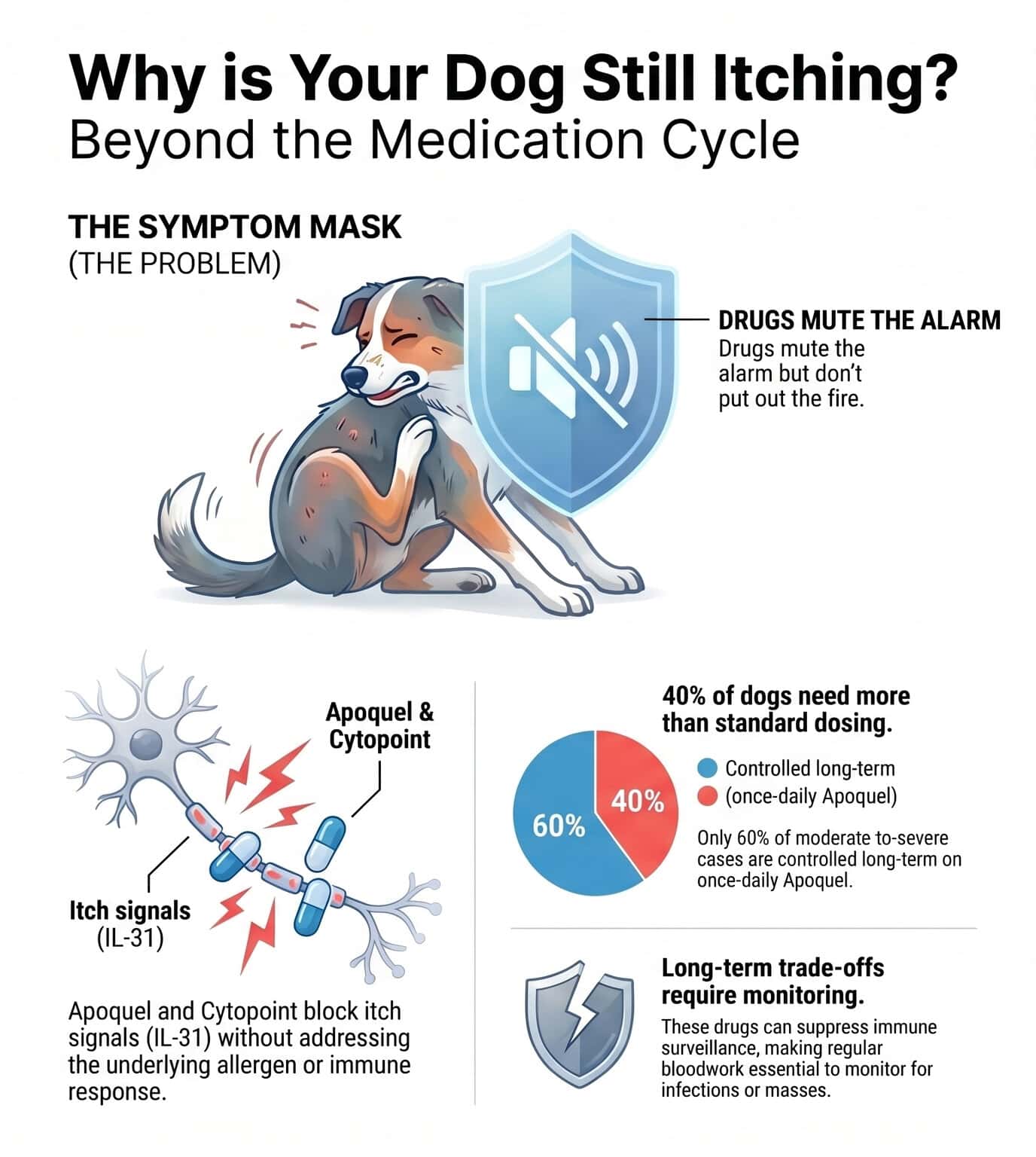
Apoquel is the brand name for oclacitinib. It belongs to a class of drugs called JAK inhibitors. JAK (Janus kinase) enzymes transmit signals from inflammatory cytokines, including IL-31, the molecule responsible for telling your dog’s brain “itch here”. By inhibiting JAK1, Apoquel interrupts that signal at the cellular level, usually within four hours. The itch stops. The underlying inflammation, allergen exposure, immune dysregulation and any food sensitivities that are driving the response are still there. The drug has simply muted the alarm.
Cytopoint takes a different mechanical route to the same destination. The active ingredient, lokivetmab, is a monoclonal antibody that binds to and neutralises IL-31 directly, before it can reach the nerve receptors in the skin. One subcutaneous injection lasts roughly four to eight weeks. Like Apoquel, it suppresses the symptoms. It does not modify the cause.
Both drugs were designed for one job: control pruritus in dogs with atopic or allergic dermatitis. They do that job well. Both manufacturers describe atopic dermatitis as a lifelong condition requiring ongoing management, which is an honest framing. It also means once you start, you tend to keep going.
What the data sheets actually say
This is where pet parents are often surprised. The information is public. It just doesn’t usually come up in the consult.
For Apoquel, the FDA has expanded its safety communication in recent years to flag several concerns from post-market surveillance. Reported events include serious infections such as bacterial pneumonia, deep skin infections and disseminated fungal disease, as well as new benign and malignant skin masses, including mast cell tumours and lymphomas, observed during long-term therapy. The mechanism explains the pattern: JAK-STAT signalling plays a role in normal immune surveillance, including the body’s ability to identify and clear abnormal cells. Suppress the pathway, and you suppress part of the surveillance.
Bone marrow suppression is the other documented concern. A veterinary dermatologist with significant Apoquel experience reports that it occurs in approximately 1% of treated dogs, often with no outward signs and only visible on bloodwork. That is why bloodwork is recommended around the two- to three-month mark.
The efficacy picture is also worth looking at honestly. The manufacturer’s own figure is that roughly 60% of moderate-to-severe atopic dermatitis cases are controlled long term on once-daily dosing. The other 40% need either higher doses, combination therapy, or alternative approaches.
Cytopoint has a cleaner short-term safety profile, but the same structural problem. It controls the itch, not the disease. Over months and years, some dogs develop anti-drug antibodies that reduce the treatment’s effectiveness. And because the underlying barrier dysfunction and immune dysregulation persist, secondary infections can emerge once the itch is masked, but the skin remains compromised.
None of this means the drugs are dangerous. It means they are pharmaceuticals with trade-offs, often used as a first and only intervention when the cause has not been investigated.
Why are so many dogs itching in the first place
This is where the bowl comes in.
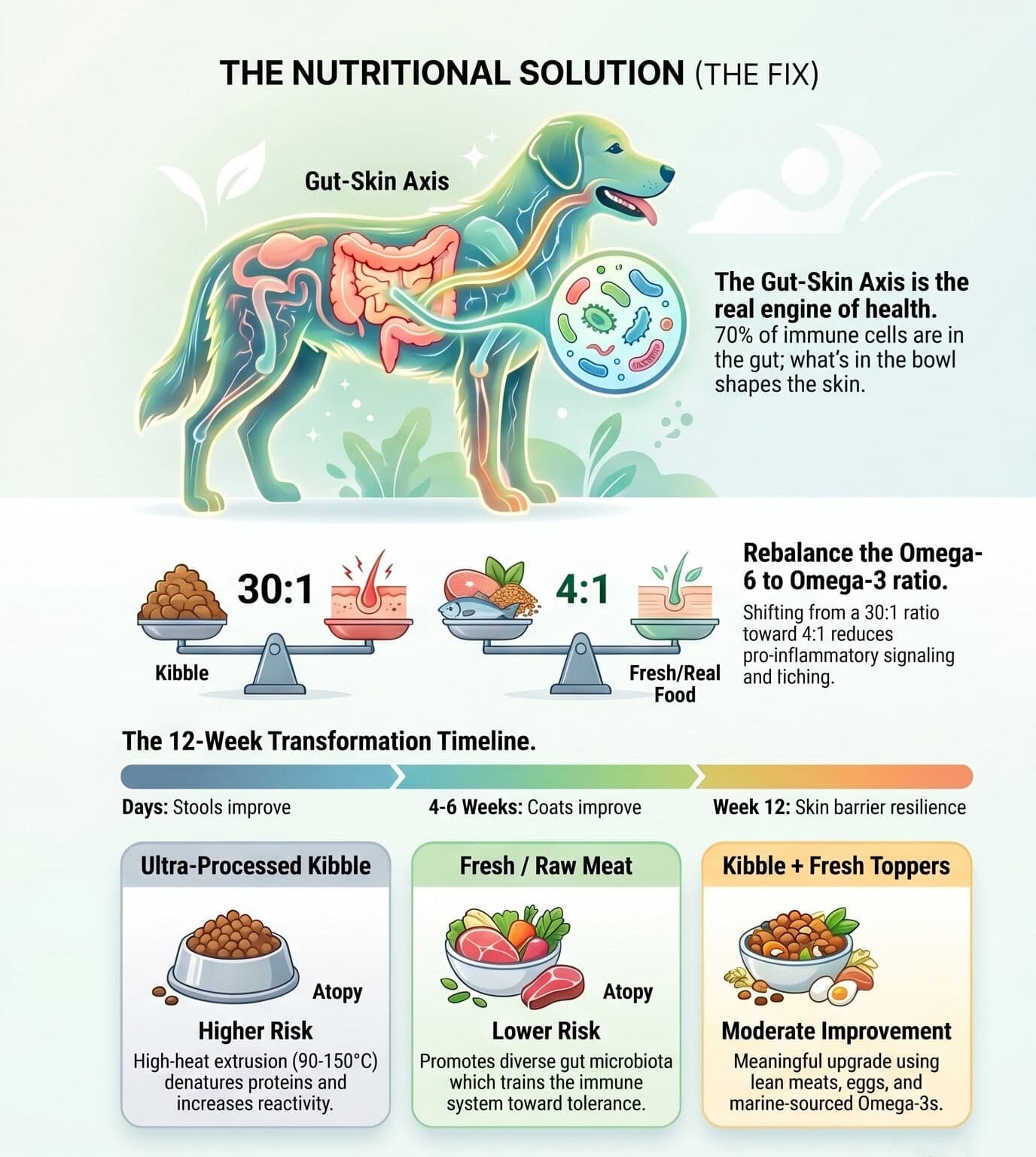
About 70% of the body’s immune cells reside in the gut. What goes into the bowl shapes the gut microbiome, which shapes immune signalling, which shapes how the skin behaves. The connection has a name in the research literature: the gut-skin axis. It is not a wellness buzzword. It is a documented immunological pathway, increasingly studied in veterinary dermatology.
A 2023 study published in Royal Society Open Science compared the gut microbiota of healthy and atopic dogs and found that diet was a dominant influence on microbial composition, with kibble-fed dogs showing markedly different patterns from those eating non-heat-processed meat-based diets. A separate study found that atopic dogs had significantly lower gut microbial diversity than healthy controls, with specific shifts in the bacterial families known to influence inflammation.
The most striking work comes from the DogRisk research group at the University of Helsinki. Their data, drawn from more than 2,200 dogs, showed that puppies started on non-heat-processed meat-based diets as their first solid food had a significantly lower risk of developing atopic dermatitis in adulthood than puppies fed ultra-processed carbohydrate diets. The protective effect held even when the mother was fed the same way during pregnancy. The mechanism, the researchers proposed, is the early-life development of a more diverse gut microbiome, which trains the immune system toward tolerance rather than overreaction.
Add to this the role of probiotics. A 2024 study published in BMC Microbiology showed that administering probiotics to dogs with atopic dermatitis significantly improved both gut microbial diversity and clinical signs of the disease, supporting the idea that the skin and the gut are in constant communication and that this conversation matters.
This is what’s happening behind the hot spots, the paw licking, the recurring ear infections and the relentless scratching. For many dogs, it’s not a freak immune system. It’s an immune system responding to what it’s being fed.
Is kibble really the problem?
Not always the only problem. Often a primary driver. And almost always the most controllable variable in the equation.
Here’s what’s actually in most bags of commercial kibble. The base is a carbohydrate-heavy formulation, typically made from maize, rice, or wheat, extruded at high temperatures (often 90 to 150°C) under pressure. The high-heat process denatures proteins, which can increase their immunogenicity. Translated: the immune system is more likely to flag heat-damaged proteins as foreign, which means more reactivity, not less.
The fat profile is the second issue. Most commercial kibble draws its fats from poultry by-products and seed oils, both of which are high in omega-6 fatty acids. Omega-6 isn’t bad in itself. It’s an essential fatty acid. The problem is the ratio. The omega-6 to omega-3 ratio in a typical kibble sits somewhere between 10:1 and 30:1. Dogs evolved closer to 4:1. Omega-6 and omega-3 compete for the same enzymes, and when omega-6 dominates, the body shifts toward pro-inflammatory signalling. Itchy skin is one of the first places that shows up.
The third issue is the absence of intact, functional nutrients. The heat processing that gives kibble its shelf life also destroys natural enzymes and degrades the bioactive compounds your dog’s gut microbiome would otherwise use as fuel. The food keeps your dog alive. It doesn’t necessarily keep her well.
This is no longer a fringe argument. There’s a growing body of evidence that connects what’s in the bowl to what’s happening on the skin.
What “real food” actually means
Real food is not a marketing word. It is a spectrum, and you can sit anywhere on it that suits your budget, your time and your dog.
At one end: a fully raw diet, formulated to be nutritionally complete, with appropriate ratios of muscle meat, organ, bone and supplementation. This is the gold standard in the research literature on protective dietary patterns. It is also the most demanding option, both in cost and in safe handling.
In the middle: gently cooked fresh food, either home-prepared from a vetted recipe or sourced from one of the South African fresh-food brands now in the market. Same principle, lower handling risk, slightly less microbiome benefit than raw, but still substantially better than ultra-processed alternatives.
At the practical end for most pet parents: kibble plus meaningful fresh additions. Lean meat, sardines, eggs, low-starch vegetables, bone broth, a high-quality omega-3 and a probiotic. This is not a perfect diet, but it’s a meaningful upgrade, and for many itchy dogs it’s enough to shift the picture.
The principle holds across the spectrum: less processed, more recognisable as food, animal-protein-led, with intact fats and enzymes. You don’t have to be perfect. You have to be better than what’s currently in the bowl.
How to transition without triggering a crisis
The most common reason a food change “fails” is that it was done too fast. Your dog’s gut microbiome has spent months or years adapting to one set of inputs. Change everything overnight and you get loose stools, gas and a frustrated owner who concludes the new food “doesn’t agree”. It does agree. The microbiome just needs time to catch up.
The reliable protocol is a 7-to-10-day gradual switch. Start at 75% old food, 25% new. Hold for two to three days. Move to 50/50. Hold for two to three days. Move to 25% old, 75% new. Hold. Then complete the switch. Watch the stools. If they loosen, hold the current ratio for an extra day or two before progressing.
The transition is also when a digestive support supplement earns its place. A product like DigestiMax combines probiotics, prebiotics and five digestive enzymes (amylase, protease, cellulase, lactase and lipase), which together help the gut adapt to new food, support microbiome rebuilding and reduce the digestive friction that causes the loose stools owners worry about. For dogs who’ve been on antibiotics, steroids or long-term Apoquel, this kind of microbiome support is especially worth considering, since each of those interventions takes a measurable toll on gut diversity.
Give the digestive supplement at least two hours apart from any antibiotics, and stay consistent. The benefits compound over weeks, not days.
Where omega-3 fits in (and why it’s not optional)
Of all the supports in a real-food approach to itchy skin, omega-3 has the deepest peer-reviewed evidence base. It is also the one most kibble-fed dogs are most deficient in.
A 2021 randomised, double-blind, placebo-controlled clinical trial published in BMC Veterinary Research tested a diet enriched with omega-3 fatty acids, antioxidants and polyphenols in 40 dogs with atopic dermatitis. After 60 days, the dogs on the enriched diet showed a 49% reduction in CADESI-4 dermatitis scores, whereas the control group showed no improvement. Owner-reported pruritus scores improved on the same trajectory.
The mechanism is biochemical, not magical. EPA, one of the two key marine omega-3 fatty acids, competes with arachidonic acid for the same enzymes that produce inflammatory eicosanoids. When you increase EPA intake, the body shifts production toward less inflammatory mediators. Less inflammation means less itch, less skin barrier breakdown and fewer flare-ups.
The other key fatty acid, DHA, integrates into cell membranes throughout the body, including in the skin. Better membrane composition means a more resilient skin barrier, which is one of the documented defects in atopic dogs.
The catch is the source. Dogs convert plant-based omega-3 (the ALA in flaxseed) to EPA and DHA at a rate of less than 5%, and cats convert almost none at all. Plant oils are not a meaningful source. What works is marine-derived fish oil with clearly stated EPA and DHA levels, ideally from cold-water sources like wild sardines and anchovies, stabilised with natural vitamin E to prevent oxidation.
This is the slot OmegaMax fills. Each pump delivers 324 mg of EPA and 214 mg of DHA from purified, molecularly distilled wild Icelandic fish oil, with natural mixed tocopherols for stability. The dosing scales by body weight, and the format (a pump bottle, oil over food) is the easiest delivery method for daily use. It is not a treatment for atopic dermatitis. It is a foundational nutritional input that the evidence supports as part of any sensible skin protocol.
When the drugs still make sense
Honesty matters here, because the worst version of the food-versus-drugs argument is the one that pretends drugs are never warranted. They sometimes are.
Some dogs have severe environmental atopic dermatitis driven by pollen, dust mites, mould or grass, and no amount of dietary change will eliminate the exposure. For those dogs, pharmaceutical management is reasonable, ethical and often necessary to maintain quality of life while you investigate longer-term strategies such as allergen-specific immunotherapy, environmental controls and nutritional optimisation.
Some dogs have acute flares that need to be brought under control before any other approach can work. A short course of Apoquel or a single Cytopoint injection to break a severe itch-scratch cycle, while you change the food and investigate the cause, is a legitimate use of these tools.
The mistake is not using the drugs. The mistake is reaching for them as the first, only and indefinite intervention, without anyone asking the simpler questions first.
The questions to ask your vet
Your vet is a partner, not an obstacle. The right questions usually get a better answer than the standard 12-minute consult delivers by default.
Try these at your next appointment:
“Could diet be a factor here? What would a structured food trial look like for him?”
“Before we go straight to Apoquel or Cytopoint, are there underlying causes we should investigate first, like food sensitivities, gut health or environmental triggers?”
“What’s the omega-6 to omega-3 ratio in his current food, and would adding an EPA-DHA supplement make sense?”
“If we do go on Apoquel, what’s the monitoring plan? When do we do bloodwork? How do we know when to reassess?”
“If we change his food and add gut and omega-3 support, what timeline should we give it before judging whether it’s working?”
Most vets will engage seriously with engaged questions. The ones who don’t are telling you something useful about whether they’re the right fit for the way you want to care for your dog.
What to expect when you change the food
Be realistic and don’t quit on day five.
Stools usually change within a few days. Often softer at first as the microbiome rebalances, then firmer and more compact than they were on kibble. This is normal.
Coat changes start at around four to six weeks. Less shedding, more shine, a softer feel. This is partly the omega-3, partly improved nutrient absorption.
Skin improvements typically show between eight and twelve weeks. Less reactive, fewer flare-ups, less licking, less scratching. Some dogs respond dramatically. Some respond modestly. A small number respond minimally, and those are the dogs for whom the underlying cause is genuinely environmental or genetic, not dietary, and pharmaceutical management may need to continue.
Keep a simple log. Daily itch score out of 10. Stool quality. Coat condition. Any flare-ups. Bring it to your next vet visit. You will have better data than most owners ever bring into the consulting room, and your vet will respond accordingly.
If your dog is currently on Apoquel or Cytopoint, do not stop the medication abruptly. Have the conversation with your vet about a structured taper, alongside the dietary changes. The goal is not to dump the drugs overnight. The goal is to address the cause so that the drugs become less necessary over time.
The bigger picture
Apoquel and Cytopoint are not villains. They are tools. They get reached for too quickly, too often and too alone, in a system where the average consult does not allow time for the slower conversation about what’s actually causing the problem.
The conversation most vets are not having is the simplest one. What’s in the bowl? For a meaningful share of itchy dogs, changing the answer to that question changes everything. Less inflammation. Better gut diversity. A stronger skin barrier. Fewer flare-ups. Less reliance on medication.
It is not a miracle. It is biochemistry, working the way it’s supposed to when you give the body the right inputs.
If you’d like to start with the two foundations that the evidence most strongly supports, OmegaMax gives your dog the EPA and DHA that the research keeps showing reduce pruritus and improve skin barrier function, and DigestiMax gives the gut microbiome the probiotic, prebiotic and enzyme support it needs to rebuild from years of processed food. Add real food to the bowl, ask your vet better questions and give it twelve weeks. Most pet parents are surprised by what changes.
#MoreYearsMoreLove. It starts with what’s in the bowl.