
Dog joint chews are everywhere, and it is easy to see why. They look like treats, your dog takes them happily and the label reads like a serious supplement. But the same format that makes a chew convenient is also what weakens it.
Once you understand what has to be added and compromised to make a supplement chewable, a dry powder starts to look like the much smarter buy for your dog’s long-term hip, joint and mobility support.
This is not about one brand. It is about what the chew format does to the ingredients inside it and why NutriFlex® joint powders sidestep every one of those problems.
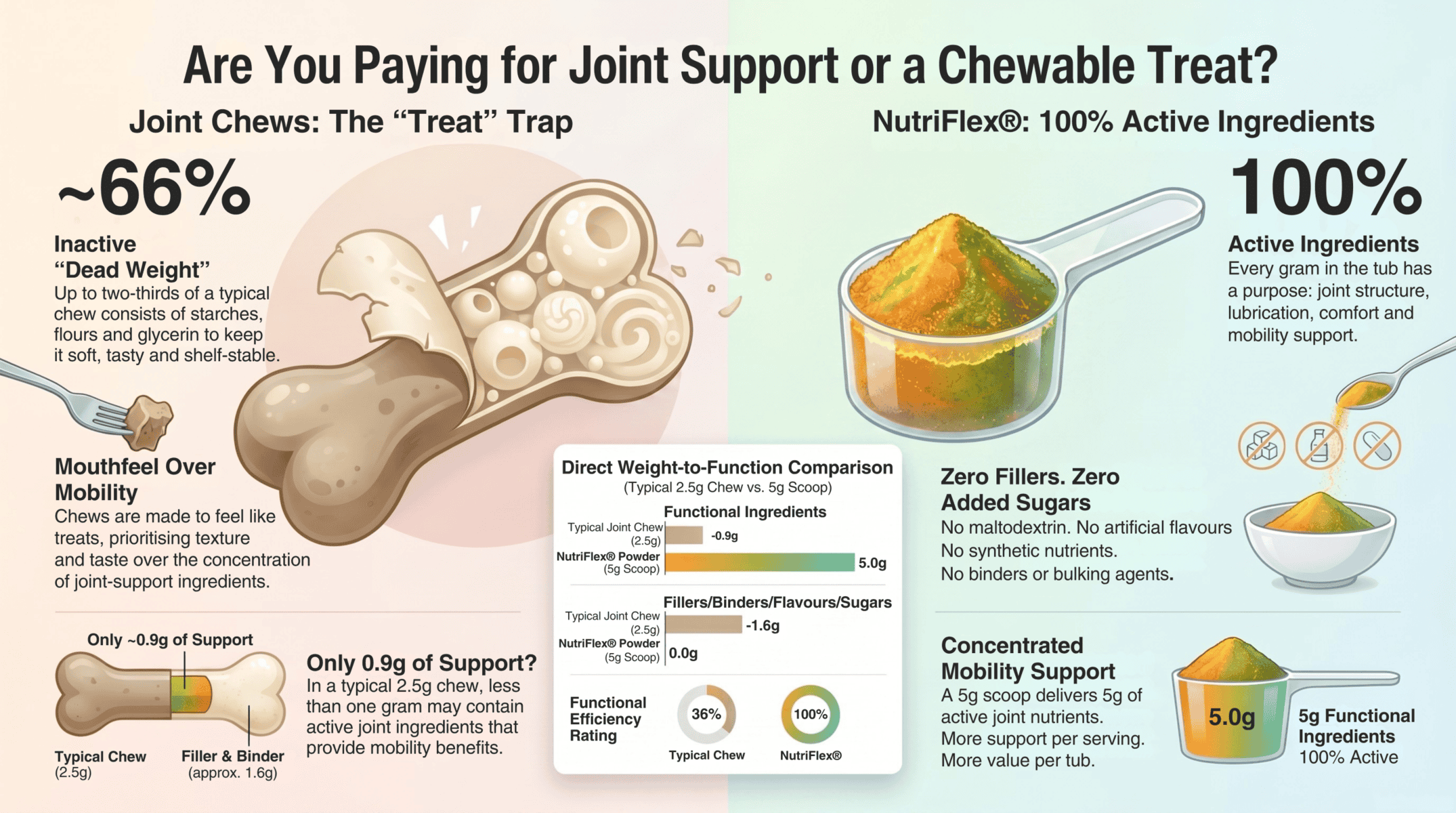
A joint chew is mostly mouthfeel, not mobility support
Start with what you are actually paying for, by weight.
Take a typical joint chew at around 2.5g per soft chew. Add up the functional ingredients on the label and they often come to less than a gram. The other two-thirds, often more, is the chew base: legume flours, starches, glycerin, sweeteners, palatants, vegetable derivatives, binders and artificial flavourings, used to hold the chew together, keep it shelf-stable and make it taste like a treat. You get convenience, but it does nothing for your pet’s joints.
It is worth knowing what those actives usually are, too. Much of the glucosamine and chondroitin in soft chews is synthetic or industrially manufactured rather than drawn from a whole-food source and as we cover further down, the evidence for those two on their own is weaker than the packaging suggests. So even the part you are meant to be paying for is often the cheap, isolated version.
The marketing talks about the handful of actives on the front. The real health story sits in the inactive ingredients underneath them.
Here is what those typical inactive ingredients are doing and the catch with each.
| Inactive ingredient | Purpose | The catch |
|---|---|---|
| Brewer’s yeast | Palatant and protein filler | One of the more common food sensitivities in dogs. Can aggravate itching, ear infections and skin flare-ups in yeast-prone pets. |
| Glycerin | Humectant, keeps the chew soft | A sweet carbohydrate that adds daily calories. In quantity it can loosen stools. |
| Maltodextrin | Binder and sweetener | A highly processed starch sugar with a very high glycaemic index. Spikes blood sugar, adds empty calories and feeds the inflammatory load. |
| Pea flour | Binder and bulk | A legume. Carbohydrate-heavy, and part of the pulse-based ingredient group the US FDA flagged in its ongoing investigation into diet-associated DCM, a serious heart condition. Also used to lift the protein reading on a label without adding meat. |
| Tapioca flour | Binder | Almost pure starch. High glycaemic, no joint value and more carbohydrate the chew does not need. |
| Poultry oil | Binder, mouthfeel and palatant | A low-cost rendered fat that is calorie-dense and prone to going rancid. Can trigger digestive upset and is a recognised risk for pancreatitis flare-ups in prone dogs. |
| Chickpea flour | Binder and bulk | Another legume, with the same FDA heart-health concern as pea flour and another dose of daily carbohydrate. |
| Magnesium stearate | Manufacturing flow agent | A factory lubricant that stops machinery clogging. It does nothing for your pet and in volume it can interfere with how other ingredients are absorbed. |
| Calcium silicate | Anti-caking agent | An industrial drying additive used to keep powder free-flowing during production. No nutritional value to your dog whatsoever. |
| Sodium triphosphate | Emulsifier and moisture retainer | A phosphate additive that adds sodium and phosphate to the daily load. That is the opposite of what you want for an older pet, where keeping phosphate intake down matters for kidney health. |
| Chicken flavouring | Palatant | Pure taste. Chicken is also one of the most common canine food allergens. |
How to check any joint chew label in 30 seconds
You do not need a nutrition degree to protect your dog from a weak product. Three quick checks on the back of the tub tell you most of what you need to know.
Check the first three ingredients. Ingredients are listed by weight. If a flour, starch or syrup appears before the joint actives, you are holding a treat with a sprinkle of supplement.
Check the milligrams per chew, not per tub. Find how many chews your dog’s weight requires per day, then work out the real daily dose of collagen, chondroitin or MSM. It is often a fraction of what the research supports. The industry even has a name for listing an impressive ingredient at a dose too small to matter: fairy dusting. The ingredient earns its place on the label, not in your dog’s joints.
Check the length of the inactive list. Every inactive ingredient is a share of the chew doing nothing for your dog’s joints, and as the table above shows, several of them quietly work against the dogs most likely to need joint support.
And if a label names its actives but will not disclose milligram amounts at all, treat that silence as an answer in itself.
Run the same check on a NutriFlex® tub and the exercise takes five seconds. The actives are the entire label. There is nothing else to find.
Look at where the bulk goes. The chew is held together by legume flours and tapioca starch, sweetened and softened with glycerin and maltodextrin, greased with poultry oil and made irresistible with yeast and chicken flavouring. Several of those carry real downsides for the exact dogs most likely to be on a joint supplement: older, heavier, itch-prone or sensitive animals. The legumes sit inside an unresolved FDA heart-health investigation. The starches and maltodextrin add refined carbohydrate and calories every single day. The yeast and chicken are among the most common allergy triggers in dogs. The poultry oil is a known risk for pancreatitis-prone pets and the added phosphate is the last thing an older pet’s kidneys need.
Then there is the part nobody markets at all. Magnesium stearate and calcium silicate are not nutrition. They are factory processing aids, there to keep the production line running, sitting in something you are asked to feed your dog every single day.
That is the trade buried in the convenience. To make a supplement soft, sweet, shelf-stable and impossible to refuse, you have to build it mostly out of things that have nothing to do with joints and in several cases work against the pet eating them.
A joint powder carries no such dead weight. NutriFlex® daily Maintenance collagen and Advanced hip and joint supplement contain 100% functional ingredients per 5 g scoop, with no with no legume flours, starch binders, glycerin, maltodextrin, added oils, phosphates or factory flow agents. Every gram in the NutriFlex® tub has a clinically validated joint function and the joint nutrients come from a whole collagen matrix rather than cheap, isolated synthetics. In every typical chew, roughly two-thirds of every gram is unwanted carbs, starches and inactive carrier material that your pet still has to eat. With NutriFlex®, you are never paying for a treat dressed up as a supplement and you are never feeding your dog a long list of reasons to flare up. You are paying for concentrated functional joint ingredients that help your pet move better, stay stronger and age more comfortably.
The chew-making process can damage the ingredients that matter
To turn a paste into a soft, shelf-stable chew, you have to process it, usually with heat, moisture and binders. That matters because the compounds that make a quality joint supplement work are structurally sensitive.
The value of a premium joint supplement and collagen matrix is not just the collagen itself. It is the naturally occurring co-factors that come with it: hyaluronic acid, glycosaminoglycans (GAGs) and proteoglycans. These are exactly the kind of delicate, bioactive molecules that processing degrades. The biological activity of collagen itself depends on its molecular structure staying intact, and in manufacturing, thermal processing such as extrusion is the single biggest cause of that structure breaking down.[1][2]
A powder supplement skips that step entirely. NutriFlex® supplements are cold-blended and packed dry, so the collagen matrix and its natural co-factors reach the bowl intact. You are feeding the ingredients as they were extracted, not as they survived the oven.
The problem with chews is dose control
A soft chew is a fixed unit. One chew is one chew, whether it is going to a 4 kg cat or a 40 kg dog. That means small pets can end up eating more unnecessary starches, binders and carrier material than they need, while large pets may need several carb-heavy chews before they get a meaningful active dose.
A powder scales properly. With NutriFlex®, you dose by weight, from half a scoop for a small cat up to two scoops for a large dog, and you can double it during the first month or through a recovery period. The active dose follows the animal, not the mould the chew was set in.
That control also shows up in the numbers. NutriFlex® Advanced delivers, per 5 g scoop, 3,300 mg of hydrolysed Type I and III collagen, 1,000mg of a patented Type II collagen matrix (naturally carrying chondroitin, GAGs, proteoglycans and hyaluronic acid), 500mg of OptiMSM and 200mg of Vitamin C to support the pet’s own collagen production. That is proper, weight-appropriate joint supplementation, not a token sprinkle of actives wrapped in a starch-heavy chew.
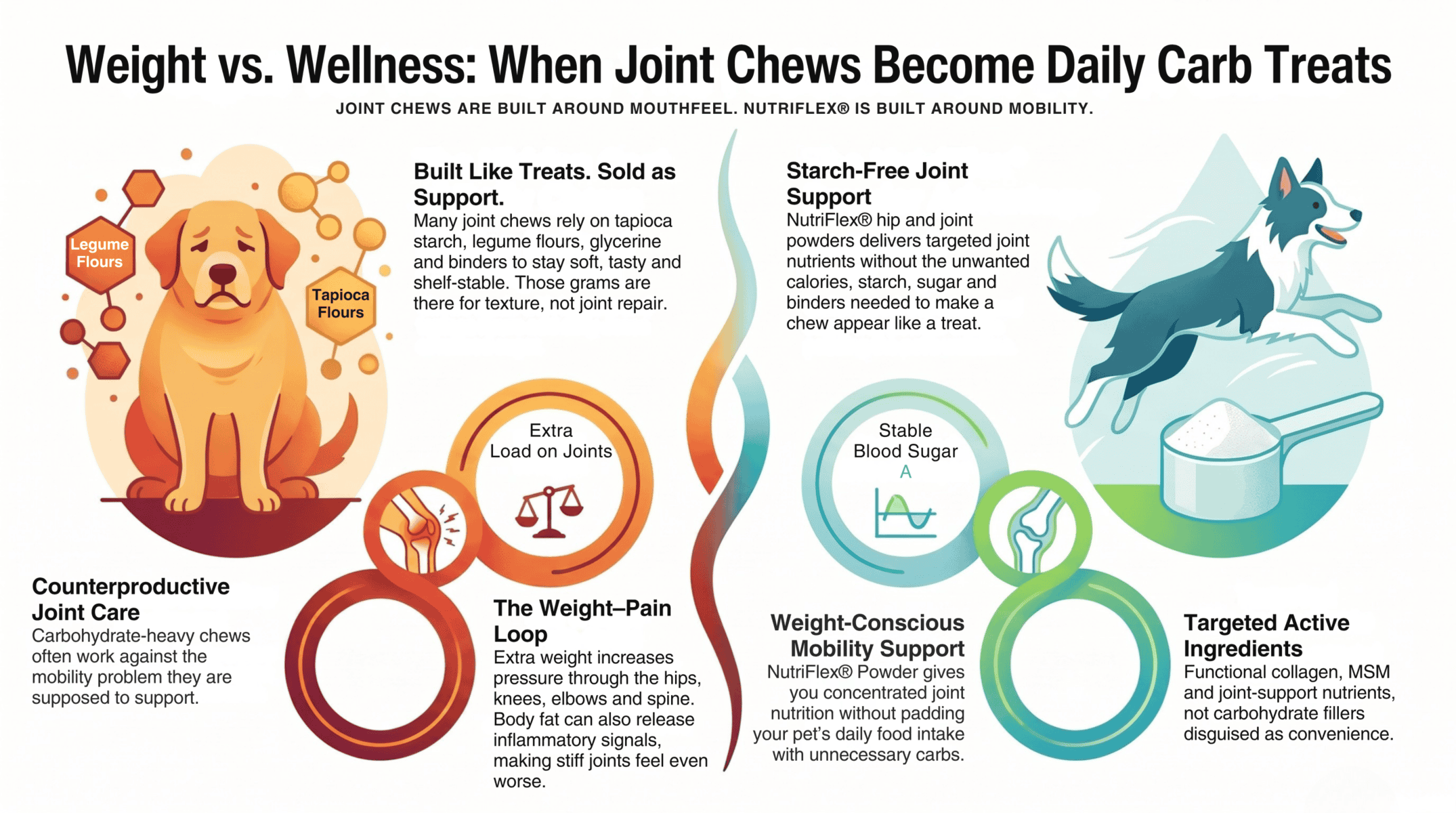
The hidden cost of a daily carb treat
Many chews rely on legume and tapioca starch, rice and maize flours and other carb-heavy binders to hold their shape and taste like a treat. That means every daily chew can add a hit of refined carbohydrates and unwanted calories. For an older, overweight or arthritic pet, that is the wrong trade-off, because excess weight is one of the biggest drivers of joint pain in the first place. So the chew is quietly adding to the problem it is supposed to support.
A powder adds none of that. NutriFlex® joint supplements are unflavoured, odourless and sugar-free, so they support the joints without spiking blood sugar or padding the waistline. It also avoids common allergen sources. Many chews draw glucosamine from shellfish and chondroitin from pork, while NutriFlex® is extracted from bovine and chicken sternum and contains no shellfish or marine derivatives.
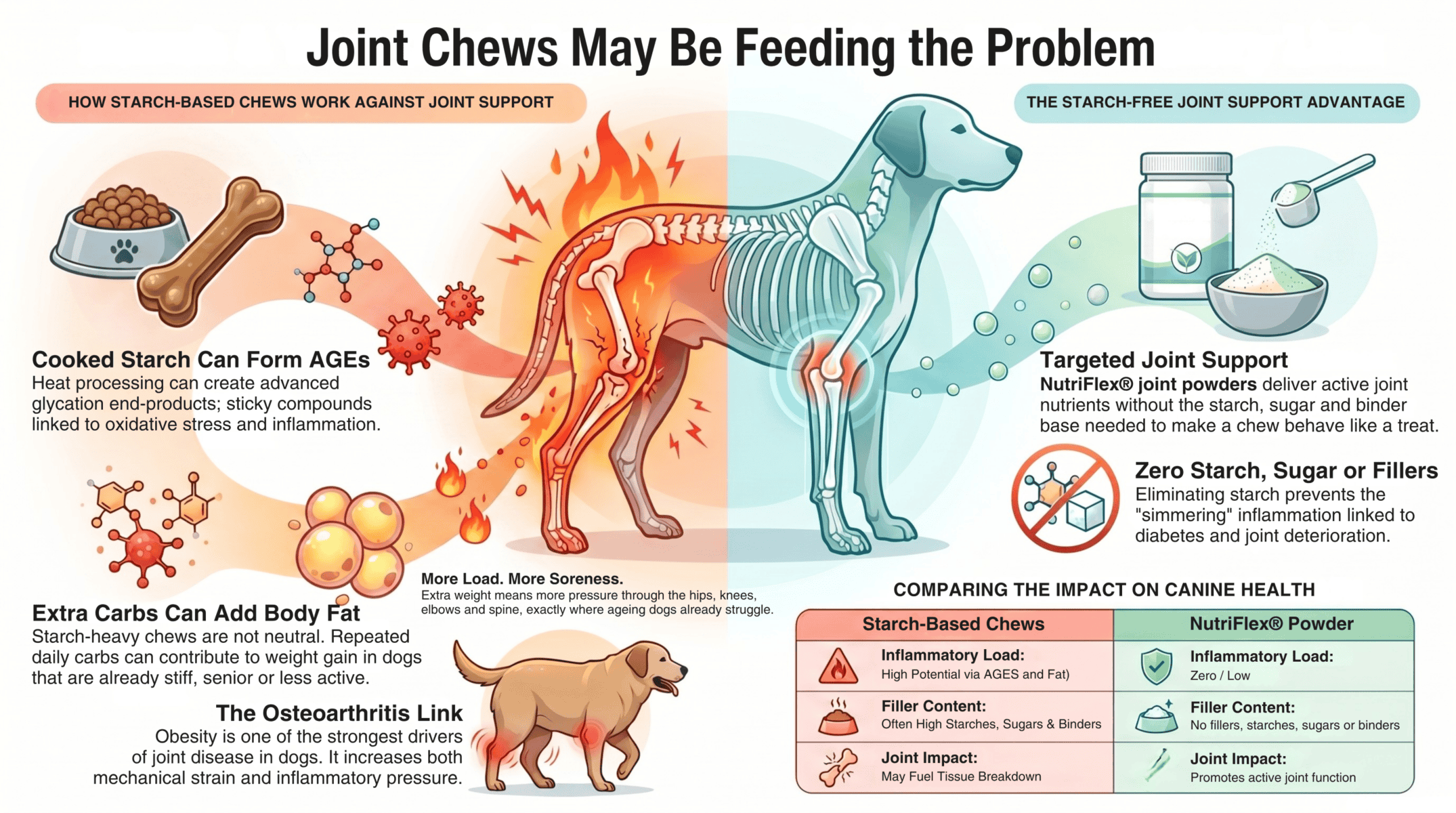
Carbs and starches do not just add weight; they fuel inflammation
The carb load in a chew is not just a weight problem. Refined carbohydrates and starch-heavy chews can create two problems at once: they add unnecessary carbohydrates and feed inflammatory pathways in the body. Inflammation is the main engine driving joint disease and is exactly what sore, ageing joints do not need.
This happens in two main ways.
First, through compounds called advanced glycation end-products, or AGEs. Think of them as sticky damage molecules. They form when starches and sugars are cooked at high heat, the same browning reaction that helps make a chew smell and taste appealing and they can also form inside the body when blood sugar is repeatedly pushed up by a carbohydrate-heavy diet.
Once formed, AGEs can build up in tissues, bind to proteins and fats and activate a receptor called RAGE, which switches on inflammatory signalling. That matters for joints because chronic inflammation is closely linked to arthritis and tissue breakdown. Processed, carbohydrate-heavy pet foods have also been shown to carry far higher AGE loads than fresh, low-starch diets.[3][4]
Second, through body fat. When a pet eats more carbohydrates than their body can use, the excess can be stored as fat. And fat is not harmless padding. It behaves like an active inflammatory organ, releasing chemical messengers such as TNF-alpha, IL-6 and leptin. That creates a steady background level of inflammation throughout the body. For a dog or cat already dealing with stiff, sore or ageing joints, that is the last thing you want. Obesity is now understood to play a causal role in osteoarthritis, not merely sit alongside it.[5][6]
So a daily, starch-based chew can work against joint health from both directions: it supplies the raw material for AGEs and it feeds the fat tissue that keeps inflammation simmering. For a dog already managing stiff or ageing joints, that is the opposite of what a joint supplement should be doing. The same logic applies to overall canine health, since this low-grade inflammation also tracks with diabetes, pancreatitis and other chronic diseases.
This is the heart of the case for a powder. NutriFlex® carries no starch, no sugar and no filler, so it supports the joints without adding to the inflammatory load. You are treating the joint, not quietly feeding the problem.
What about glucosamine and the rest?
Joint chews for dogs often rely heavily on glucosamine and chondroitin, which are often synthetic or industrially manufactured rather than drawn from whole-food sources and the evidence for those two on their own is weaker than the packaging suggests. A 2022 meta-analysis found that supplements based on glucosamine and chondroitin had no proven efficacy and a 2023 trial found that glucosamine was no better than a placebo while other approaches clearly outperformed it.[7][8] NutriFlex® takes a different route, delivering chondroitin, GAGs and hyaluronic acid as part of a whole collagen matrix rather than as isolated, bolted-on actives, alongside MSM and Vitamin C, which support the body’s own joint and tissue repair.
The bottom line
We get it. You love your dog. You want the easy option. You want something they will take happily, without fuss, without hiding powder in food, without turning supplement time into a negotiation.
That is exactly why joint chews are such an easy sell. But convenience has a cost.
Joint chews for dogs sell you convenience and charge you for starch and unnecessary calories. They are often built like treats that happen to contain a sprinkle of joint actives. To make them soft, tasty, chewable and shelf-stable, they usually need starches, flours, glycerine, binders, flavourants or sugars. In many cases, a large part of the chew is not there to support the joint at all. It is there to make the product soft, tasty and almost impossible for your dog to refuse.
So while the label may talk about mobility, glucosamine, collagen or MSM, your dog may also be getting a daily dose of filler, carbohydrate and unwanted calories. For a young, lean, highly active dog, that may not seem like a big deal. But for older dogs, stiff dogs, overweight dogs, arthritic dogs or diabetic pets, that extra daily load is not harmless. It can work against the very problem you are trying to fix.
That is the uncomfortable truth: sometimes we overfeed, overtreat and over-convenience our pets in the name of love. We mean well. But kindness becomes a problem when the format is making the supplement weaker, heavier and less appropriate for long-term joint care.
NutriFlex® joint powders solve the problem in one clean move. With Daily Maintenance and Advanced Hip & Joint Care, you get 100% active ingredients, an intact collagen matrix and a dose you can adjust properly to your pet’s size and needs: no fillers and no sugar, starting at less than R295 per tub and less when you stock up. The chew is the easier sell. The powder is the superior supplement; cleaner, more concentrated and more biologically appropriate for long-term hip and joint support.
Because love is not just giving them what they want in the moment. It is choosing what helps keep them moving, climbing, playing and walking beside you for longer. More Years. More Love.
Frequently Asked Questions
Are dog joint chews worth it?
Dog joint chews can be worth it when they provide a meaningful active dose and do not rely heavily on starches, sugars or binders. Many soft chews contain joint-support ingredients alongside inactive chew-base ingredients used for texture, taste and shelf stability. Compare products by active ingredient dose per serving, not by the number of chews in the tub.
Do dog joint chews actually work?
It depends on the dose and the ingredients. Many chews rely on glucosamine and chondroitin and recent trials question how well those perform on their own. Heat and binders used to form a chew can also degrade functional ingredients and their natural co-factors, so the active dose that reaches your dog is often lower than the label suggests and always avoid assuming that a treat-like chew contains a full functional dose.
Are joint chews or powder better for dogs?
Powder is the stronger supplement. It carries no fillers or sugar, the dose scales to your dog’s weight and it is cold-blended so the joint nutrients stays intact. Chews win on convenience, but a large part of each chew is starch and calories that do nothing for the joints and can add to inflammation in older or overweight dogs.
Can dog joint chews cause weight gain?
They can. Many chews use legume, tapioca, rice or maize starch to hold their shape, adding refined carbohydrates and calories every day. For an older, arthritic or overweight dog, that extra load works against joint health, since excess weight is one of the biggest drivers of joint pain. A sugar-free, starch-free, low-calorie powder avoids this problem.
What should I avoid in joint chews for dogs?
Watch for maltodextrin, legume flours (pea or chickpea), tapioca, rice or potato starch, glycerin, brewer’s yeast, added sugars and artificial flavourings high on the ingredient list. Be equally wary of labels that name impressive actives without disclosing milligram amounts per chew. Ingredients are listed by weight, so anything appearing before the joint actives makes up more of the chew than the joint support does.
How long do joint supplements take to work in dogs?
Expect gradual improvement over four to eight weeks of consistent daily use, whether the nutrients arrive in a chew or a scoop. Joint tissue rebuilds slowly, and supplements support the joint’s own repair and lubrication processes rather than masking symptoms. Any product promising overnight transformation deserves scepticism. What matters is the daily active dose reaching the joint, which is exactly where a clean powder outperforms a filler-heavy chew.
Sources
- ↑ Undenatured Type II Collagen (UC-II) in Joint Health: review of companion animal evidence, MDPI Animals (2020). https://www.mdpi.com/2076-2615/10/4/697
- ↑ Collagen retention and degradation during food processing (2023). https://www.ncbi.nlm.nih.gov/pmc/articles/PMC10293959/
- ↑ Immunomodulation by processed animal feed: Maillard reaction products and AGEs, Frontiers in Immunology (2018). https://www.frontiersin.org/journals/immunology/articles/10.3389/fimmu.2018.02088/full
- ↑ Advanced glycation end products in differently processed canine diets, Journal of Animal Physiology and Animal Nutrition (2024). https://www.ncbi.nlm.nih.gov/pmc/articles/PMC11327896/
- ↑ Weight-related conditions and chronic low-grade inflammation, Purina Institute. https://www.purinainstitute.com/science-of-nutrition/managing-healthy-weight/weight-related-conditions
- ↑ Pro-inflammatory cytokines: the link between obesity and osteoarthritis (2018). https://pubmed.ncbi.nlm.nih.gov/30340925/
- ↑ Glucosamine and chondroitin in canine and feline osteoarthritis, VetTimes. https://www.vettimes.com/news/vets/small-animal-vets/glucosamine-and-chondroitin-in-managing-canine-and-feline-oa
- ↑ Glucosamine vs marine-based supplements and carprofen in canine hip osteoarthritis, randomised trial (2023). https://www.ncbi.nlm.nih.gov/pmc/articles/PMC9929184/
- NutriFlex® Advanced Hip and Joint Care, product formulation and serving data. https://www.nutriflex.co.za/product/advanced-collagen-powder-for-dogs-and-cats/