
Why Omega-3 and Omega-6 Are Essential in Your Dog’s Diet
Dog food omega 3 and 6 fatty acids are nutrients your dog cannot produce on their own. They must come from food or supplements. Without them, your dog’s skin, joints, brain and immune system cannot function properly.
Quick answer: what do omega-3 and omega-6 do for dogs?
| Fatty Acid | Key Role | Best Sources |
|---|---|---|
| Omega-3 (EPA, DHA) | Reduces inflammation, supports brain, joints and skin | Salmon, sardines, fish oil |
| Omega-3 (ALA) | Precursor to EPA and DHA, heart and brain support | Flaxseed oil |
| Omega-6 (LA) | Skin integrity, immune function, reproduction | Sunflower oil, chicken fat |
| Omega-6 (AA) | Growth and immune response | Animal fats |
- Both fatty acids are essential, meaning your dog’s body cannot make them
- Most standard kibble does not deliver adequate levels of EPA and DHA
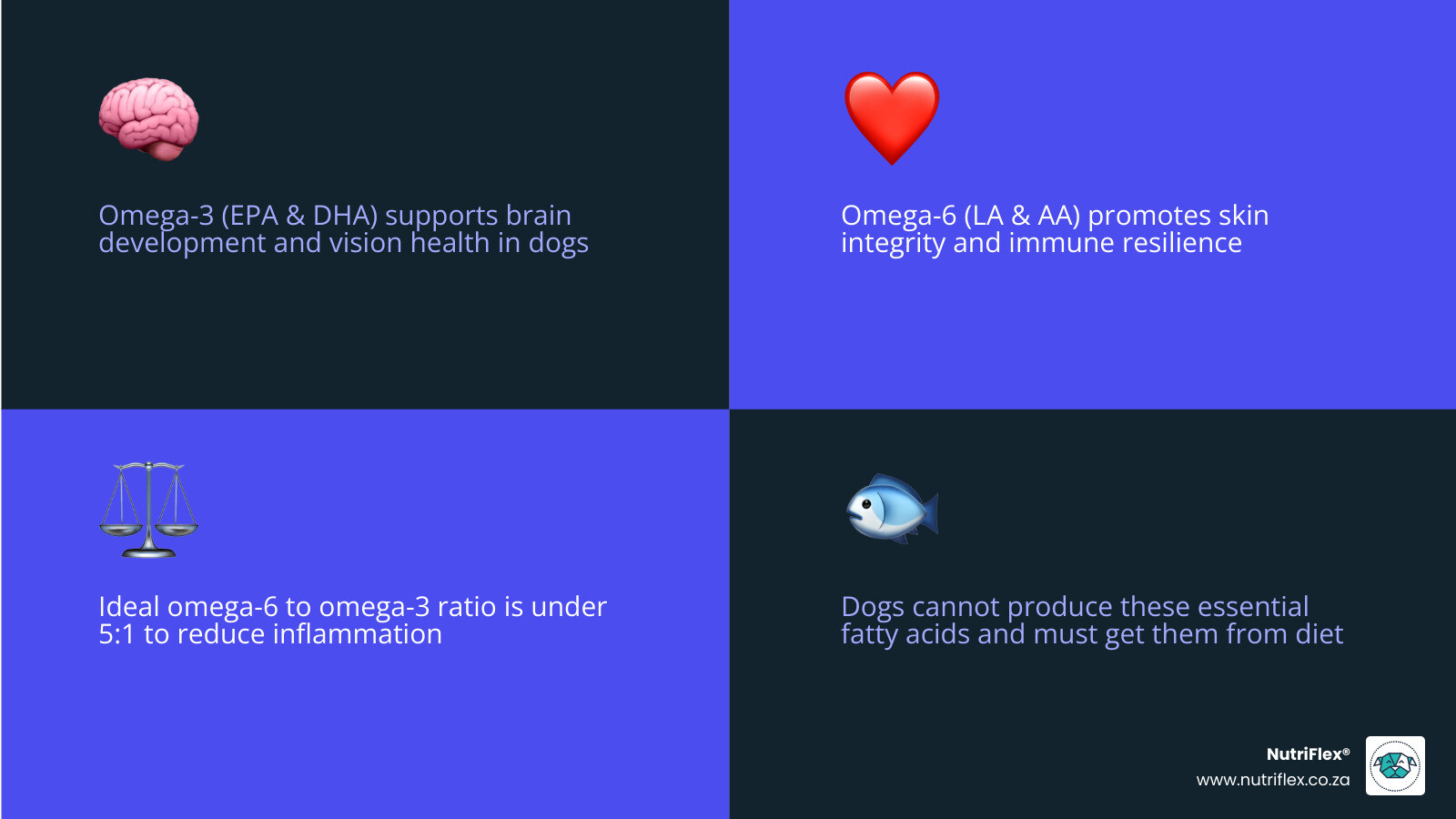
- The ideal omega-6 to omega-3 ratio is less than 5:1 to help manage inflammation
- Signs of deficiency include a dull coat, itchy skin and poor wound healing
- Supplementing with a quality fish oil can help bridge the gap
Most dog owners focus on protein and calories. Fatty acids rarely get the attention they deserve, yet the science is clear: getting this balance right has a measurable impact on your dog’s long-term health, from puppyhood through to the senior years.
I’m Sharon Milani, co-founder of NutriFlex® and a South African pet supplement formulator with over seven years of experience developing certified human-grade omega-3 products for dogs and cats. My work in dog food omega 3 and 6 nutrition is grounded in both veterinary collaboration and the very real experience of watching a well-supplemented dog regain his quality of life. In the sections that follow, we break down exactly what these fatty acids do, where to find them and how to make sure your dog is getting enough.
Understanding Essential Fatty Acids in Dog Food Omega 3 and 6
To understand why dog food omega 3 and 6 levels matter, we need to look at what they actually are. These are polyunsaturated fats, often described as “good fats.” Chemically, they consist of long lipid chains. Because a dog’s body lacks the enzymes to produce these specific carbon bonds at certain positions, they are classified as “essential.” If they aren’t in the bowl, they aren’t in the dog.
These fatty acids are the building blocks of cell membranes. They influence how cells communicate and how the body responds to injury or infection. Scientific research on EPA shows that it can reduce triglyceride levels and help manage pain and swelling by interfering with inflammatory pathways. For a deeper dive into the basics, you can explore more info about omega 3 for dogs to see how these lipids transform canine vitality.
The Role of Omega-3 (EPA, DHA and ALA)
Omega-3s are the “anti-inflammatory” powerhouses. There are three main types you will see on a dog food omega 3 and 6 label:
- EPA (Eicosapentaenoic Acid): Primarily sourced from marine life, EPA is the heavy lifter for heart health and joint support. It works by limiting the production of pro-inflammatory chemicals.
- DHA (Docosahexaenoic Acid): This is critical for the central nervous system. Research into DHA supplementation%2C%20especially%20EPA%20and%20DHA%2C%20have%20been%20proven%20to%20act%20positively%20on%20a%20panel%20of%20human%20health%20conditions%20through%20interesting%20antioxidative%20and%20anti%2Dinflammatory%20properties.) confirms its role in puppy brain development and vision. It is also vital for senior dogs to maintain cognitive function.
- ALA (Alpha-Linolenic Acid): Found in plant sources like flaxseed. While helpful, dogs are not very efficient at converting ALA into the more useful EPA and DHA. You can find more ALA info regarding its presence in seeds and organ meats.
The Role of Omega-6 (LA and AA)
Omega-6 fatty acids often get a bad reputation for being “pro-inflammatory,” but they are absolutely necessary for life. They trigger the immune response that helps a dog heal from injury.
- Linoleic Acid (LA): This is the primary omega-6. It is essential for maintaining the skin’s water barrier. Without enough LA, a dog’s skin becomes permeable, leading to “leaky skin” and allergies.
- Arachidonic Acid (AA): While cats must eat AA, dogs can actually produce it if they have enough LA. It plays a key role in growth, reproductive function and the initial stages of the immune response.
The Vital Health Benefits of Omega-3 and Omega-6

When the balance of dog food omega 3 and 6 is correct, the results are visible. We often see dogs “glowing” after a few weeks of proper supplementation. The benefits extend far beyond just looking good; they reach deep into the organs and joints. For a comprehensive look at these perks, check out more info about fish oil benefits.
Managing Chronic Conditions
We frequently recommend increasing omega-3 intake for dogs facing long-term health challenges:
- Arthritis Relief: High doses of EPA and DHA can reduce the need for non-steroidal anti-inflammatory drugs (NSAIDs) by naturally soothing joint inflammation.
- Cancer Support: Omega-3s may help reduce “cancer cachexia” (muscle wasting) and have been shown in some studies to improve survival times for dogs with lymphoma.
- Allergy Reduction: By strengthening the skin barrier and reducing the body’s overreaction to environmental triggers (like pollen or dust mites), omegas can significantly decrease itching.
- Kidney Support: Omega-3s help reduce protein loss in the urine, which is a common issue in dogs with chronic kidney disease.
Puppy Development and Senior Care
Life stage matters. Puppies have a massive requirement for DHA to fuel their rapidly growing brains. Studies have shown that puppies fed higher levels of DHA are easier to train and have better memory retention.
For our senior citizens, omega fatty acids are about quality of life. They support mobility by keeping joint fluid viscous and combat “doggy dementia” by protecting neural pathways. During gestation, a mother dog needs extra omegas to ensure her litter develops healthy nervous systems and strong immune foundations.
Finding the Best Sources and the Ideal Omega Ratio
Not all fats are created equal. To get the most out of dog food omega 3 and 6, you need to look at the source. Marine sources are generally superior for dogs because they provide EPA and DHA directly, whereas plant sources require a conversion process that dogs find difficult.
| Source | Omega Type | Bioavailability |
|---|---|---|
| Salmon/Sardine Oil | Omega-3 (EPA/DHA) | High (Direct) |
| Flaxseed Oil | Omega-3 (ALA) | Low (Needs conversion) |
| Sunflower/Corn Oil | Omega-6 (LA) | High |
| Chicken Fat | Omega-6 (LA/AA) | High |
If you are wondering which fish is better, we have a guide on more info about sardines vs salmon to help you choose the right supplement for your dog’s specific needs.
Balancing the Ratio for Optimal Health
In the wild, a dog’s ancestors ate a diet with an omega-6 to omega-3 ratio of roughly 2:1 or 3:1. Modern commercial dog food omega 3 and 6 ratios are often as high as 20:1 or even 50:1. This is because corn, soy and poultry fat (all high in omega-6) are cheap and shelf-stable.
An overabundance of omega-6 can keep a dog’s body in a constant state of low-grade inflammation. We aim for a ratio of less than 5:1. By adding a high-quality fish oil, you can bring this ratio back into balance, effectively “dialing down” the inflammation.
Bioavailability of Marine vs Plant Sources
While flaxseed and chia are popular, they contain ALA. Dogs lack enough of the specific enzyme (delta-6 desaturase) to convert ALA into EPA and DHA efficiently. Only about 5% to 10% gets converted. This is why we prioritise sustainable, cold-water marine oils. These “pre-formed” omegas are ready for the dog’s body to use immediately.
How to Optimise Your Dog’s Intake and Spot Deficiencies
How much is enough? The National Research Council (NRC) suggests a minimum of 30 mg of combined EPA and DHA per kilogram of metabolic body weight. However, for therapeutic benefits (like treating arthritis), vets often recommend 50 mg to 75 mg per kilogram of actual body weight.
To make this easier, you can use an omega 3 for dogs calculator to find the sweet spot for your pet. Be mindful of the safe upper limit, which is roughly 2,800 mg per 1,000 kcal of diet.
How to Identify Quality Dog Food Omega 3 and 6 on Labels
Reading a label requires a bit of detective work. Look for:
- Specific Sources: “Salmon oil” or “Menhaden fish meal” is better than “animal fat” or “fish oil.”
- Guaranteed Analysis: Does the bag actually list the percentages of Omega-3 and Omega-6? If not, the levels might be negligible.
- Natural Preservatives: Look for tocopherols (Vitamin E) which prevent these fragile fats from going rancid.
- DHA/EPA Levels: High-quality brands will break these down specifically.
Recognising Signs of Fatty Acid Deficiency
If your dog is lacking in dog food omega 3 and 6, their body will tell you. Common signs include:
- The “Dusty” Coat: A coat that looks dull, feels coarse and seems to have “dandruff.”
- The Constant Scratch: Itching that isn’t caused by fleas, often focused on the belly and paws.
- Slow Healing: Small nicks or scratches that take a long time to scab over or heal.
- Stiff Mornings: Difficulty getting up after a nap, which may indicate joint inflammation.
- Ear Infections: Recurrent waxy or inflamed ears can be a sign of a compromised skin barrier.
Frequently Asked Questions about Dog Food Omega 3 and 6
Can I give my dog human fish oil supplements?
While the fish oil itself is often the same, human supplements can be risky. Some contain flavourings or sweeteners like xylitol, which is highly toxic to dogs. Additionally, human capsules are often dosed for a 70 kg adult, making it easy to accidentally overdose a 10 kg Terrier. It is always safer to use a product like our more info about premium fish oil which is specifically formulated and dosed for pets.
What are the risks of too much omega fatty acids?
More is not always better. Excessive fish oil can lead to:
- Diarrhea: Too much fat too quickly can upset the stomach.
- Weight Gain: Fats are calorie-dense (about 9 calories per gram).
- Blood Clotting Issues: Very high doses of omega-3 can thin the blood, which is a concern before surgery.
- Pancreatitis: Dogs with a history of pancreatitis should be very carefully monitored when adding any fats to their diet.
How long does it take to see results from omega supplementation?
Patience is key. While some dogs show a shinier coat in 2 to 3 weeks, it usually takes 6 to 12 weeks to see a significant change in skin health or joint mobility. This is because it takes time for the fatty acids to be incorporated into the cell membranes and for the old “low-omega” cells to be replaced.
Conclusion
At NutriFlex®, we believe that nutrition is the first line of defence in pet health. As a South African manufacturer based in Cape Town, we produce Act 36 registered supplements in a certified human-grade facility. Our mission is to provide science-aligned, functional nutrition that goes beyond the basic requirements of standard kibble.
By understanding the balance of dog food omega 3 and 6, you aren’t just feeding your dog; you are protecting their joints, sharpening their mind and nourishing their skin from the inside out. If you are ready to see the NutriFlex® difference, you can shop premium Omega-3 supplements and start your dog’s journey to better health today.