
Why Your Horse’s Joints Deserve Premium Natural Support
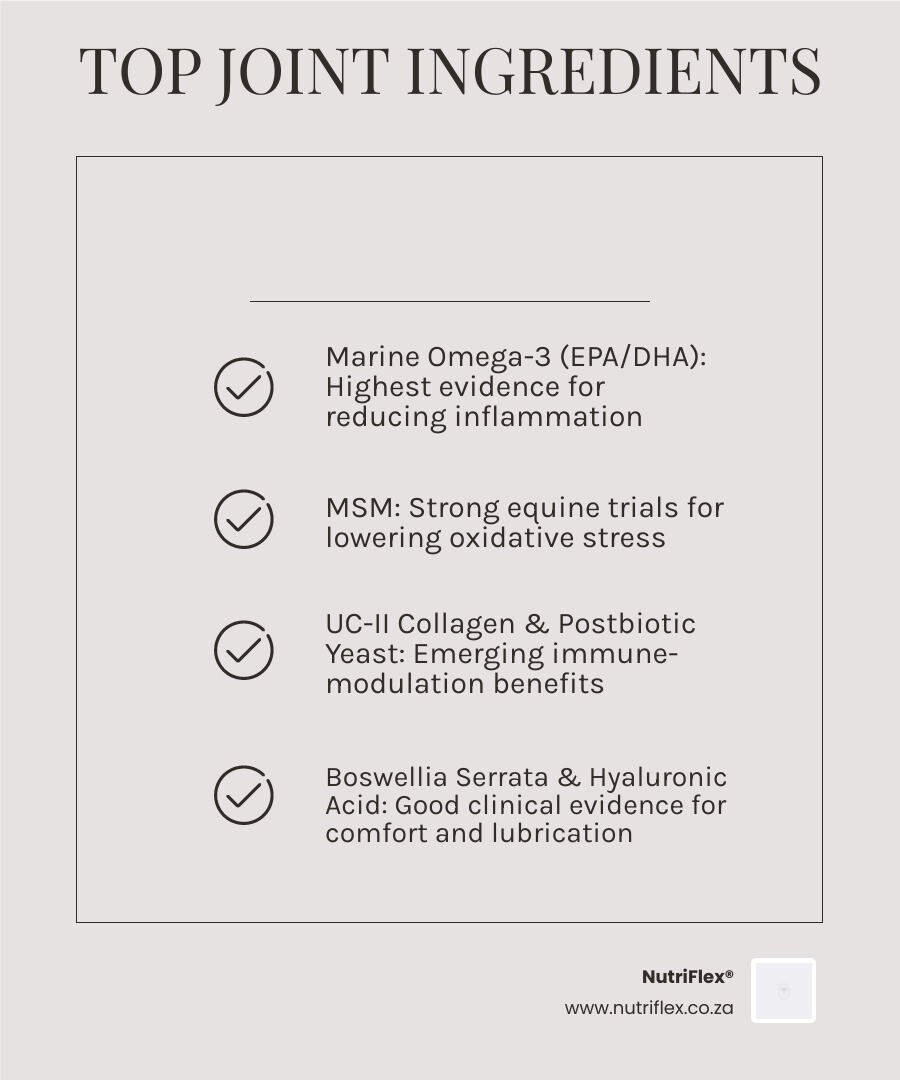
If you are looking for premium natural horse joint support, here is a quick overview of the most effective ingredients and what to look for:
| Ingredient | Primary Benefit | Evidence Level |
|---|---|---|
| Marine Omega-3 (EPA/DHA) | Reduces joint inflammation | Highest (systematic reviews) |
| MSM | Reduces oxidative stress and inflammation | Strong (equine trials) |
| Hyaluronic Acid | Supports synovial fluid quality | Good (equine studies) |
| Chondroitin Sulphate | Protects cartilage from breakdown | Moderate |
| Glucosamine HCL | Supports cartilage synthesis | Moderate (bioavailability concerns) |
| Boswellia Serrata | Natural anti-inflammatory | Good (clinical use) |
| UC-II Collagen | Cartilage preservation via immune modulation | Emerging |
| Postbiotic Yeast | Reduces inflammatory markers in joint fluid | Emerging |
Joint issues are among the top reasons horses are retired early. Yet for many owners, the signs of joint degeneration appear gradually, making it easy to miss the window where early intervention matters most.
Horses are, in every practical sense, elite athletes. They carry significant body weight across high-impact disciplines, from showjumping to endurance riding. Their joints absorb enormous stress with every stride. And unlike muscle, cartilage has no direct blood supply, meaning once it degrades, recovery is slow and often incomplete.
The challenge is not just finding a joint supplement. It is finding one that is formulated with ingredients that actually work, in forms the horse’s body can absorb and use.
That is where the science becomes essential.
I’m Sharon Milani, Director of SmartPack PTY Ltd and co-founder of NutriFlex®, South Africa’s first certified human-grade pet supplement range, and my work developing evidence-aligned joint formulations has given me a clear perspective on what separates genuine premium natural horse joint support from products that rely on marketing over substance. In this guide, I will walk you through the ingredients, mechanisms and quality standards that define effective equine joint care in the South African market.
Learn more about premium natural horse joint support:
- natural collagen hip dysplasia support
- pure natural dog joint support
- natural frankincense hip joint support
Understanding Equine Joint Degeneration and the Need for Premium Natural Horse Joint Support
Osteoarthritis and degenerative joint disease are the primary culprits behind lameness and early retirement in the South African equestrian community. Whether your horse is a competitive showjumper navigating demanding courses in Kyalami, a dressage horse performing intricate movements in Constantia or a senior companion enjoying retirement in the KwaZulu-Natal Midlands, joint wear is an inevitable consequence of motion and time.
Anatomy dictates that a joint is more than just where two bones meet. It is a complex, delicate system consisting of articular cartilage, subchondral bone, the joint capsule and the synovial membrane. The synovial membrane produces synovial fluid, a thick, slippery substance that acts as a natural lubricant and shock absorber.
As a horse ages or undergoes intensive training, the rate of cartilage wear begins to outpace the body’s natural repair mechanisms. Chondrocytes (the cells responsible for maintaining cartilage) become less efficient, and the production of high-quality synovial fluid decreases. This results in direct friction between joint structures, leading to chronic, low-grade inflammation. This inflammatory cascade releases destructive enzymes that further degrade the cartilage matrix, creating a painful cycle of degeneration.

Early Warning Signs and When to Start Supplementation
Recognising the subtle, early indicators of joint discomfort is essential for preventing irreversible structural damage. Many horse owners wait until a horse is visibly lame before introducing joint care, but reactive treatment is far more difficult and costly than proactive prevention.
The early warning signs of equine joint issues include:
- Stiffness after rest: A noticeable stiffness when first leaving the stable or paddock, which gradually improves as the horse warms up.
- Shortened stride length: A loss of forward reach, downhill hesitation or a reluctance to engage the hindquarters.
- Wind puffs: Soft, fluid-filled swellings around the fetlock joints indicating chronic joint capsule irritation.
- Joint heat and minor swelling: Localised warmth or puffiness around a joint after intensive exercise.
- Changes in behaviour: Uncharacteristic resistance to being saddled, pinning ears when asked to canter or refusing jumps.
Implementing a preventative supplementation strategy early in a horse’s life, especially prior to entering heavy training, helps protect the cartilage matrix before degradation begins. By providing targeted nutrients beforehand, you support the joint’s natural defense systems and prolong the horse’s athletic longevity. For more on the clinical evidence behind early joint intervention, you can explore the Scientific research on equine joint health.
The Science of Cartilage and Synovial Fluid Protection
The articular cartilage is a highly specialised tissue designed to withstand compression and reduce friction. It consists of chondrocytes embedded within an extracellular matrix composed of water, collagen fibres and proteoglycans. Proteoglycans are large molecules made of a core protein with attached glycosaminoglycans (GAGs) like chondroitin sulphate. These molecules act like microscopic sponges, trapping water within the cartilage structure to create a resilient, springy cushion.
Without adequate lubrication, this cushion quickly wears thin. Synovial fluid relies on hyaluronic acid to maintain its viscous, shock-absorbing properties. When joint inflammation occurs, the molecular weight of hyaluronic acid in the joint fluid drops, causing the fluid to become thin and watery. This increases friction, accelerates cartilage wear and triggers further inflammatory pathways.
| Joint Structure | Key Protective Nutrient | Mechanism of Action |
|---|---|---|
| Cartilage Matrix | Chondroitin Sulphate & Glucosamine | Stimulates GAG synthesis and inhibits destructive enzymes |
| Synovial Fluid | Hyaluronic Acid (HA) | Restores fluid viscosity and improves joint lubrication |
| Connective Tissue | Methylsulfonylmethane (MSM) | Provides bioavailable sulphur for collagen cross-linking |
| Joint Capsule | Marine Omega-3 (EPA/DHA) | Downregulates inflammatory pathways and reduces swelling |
Synergistic Action of Glucosamine, Chondroitin and Hyaluronic Acid
For decades, the combination of glucosamine, chondroitin sulphate and hyaluronic acid has formed the foundation of equine joint support. These ingredients work most effectively when administered together, as they target different pathways of cartilage synthesis and fluid maintenance.
Glucosamine HCL serves as a fundamental building block for the synthesis of GAGs and proteoglycans. It stimulates chondrocytes to produce new cartilage matrix and helps support the repair of damaged tissue. Chondroitin sulphate acts as a protective shield, inhibiting the destructive enzymes (such as metalloproteinases) that break down cartilage during inflammation.
Hyaluronic acid completes this trio by directly supporting the quality of the synovial fluid. Research indicates that oral supplementation with low molecular weight hyaluronic acid (typically between 100 mg and 250 mg daily) is absorbed more efficiently by the body, helping to restore joint fluid viscosity and reduce friction within the joint capsule. To understand how these classic joint-supporting compounds compare to human-grade standards, read this More info about human-grade joint ingredients guide.
The Role of MSM and Omega-3 Fatty Acids in Managing Inflammation
While building blocks like glucosamine and chondroitin support physical structure, managing the inflammatory cascade requires targeted anti-inflammatory agents. Methylsulfonylmethane (MSM) and marine-sourced omega-3 fatty acids are two of the most thoroughly researched natural compounds for this purpose.
MSM is an organic sulphur compound that provides the essential sulphur-to-sulphur bonds required to give collagen and connective tissues their strength. In a notable 2008 study using competitive jumping horses aged 8 to 13 years, daily supplementation of MSM at 8 mg per kg of body weight for five weeks protected the horses from oxidative stress and exercise-induced inflammation associated with weekly competition.
In addition to MSM, omega-3 fatty acids, specifically eicosapentaenoic acid (EPA) and docosahexaenoic acid (DHA), are highly regarded for their anti-inflammatory properties. A systematic review evaluating joint supplements across dogs, cats and horses concluded that marine-sourced omega-3 fatty acids hold the highest strength of evidence for reducing clinical symptoms of joint inflammation. EPA and DHA actively displace pro-inflammatory omega-6 fatty acids in cell membranes, reducing the production of inflammatory mediators like prostaglandins. For additional scientific context on how these compounds perform in clinical trials, consult the Scientific research on equine joint supplements.
Next-Generation Ingredients in Premium Natural Horse Joint Support
As veterinary science advances, equine nutritionists are looking beyond traditional joint ingredients to target systemic pathways of inflammation and tissue recovery.
One of the most exciting developments is the use of postbiotic yeast compounds derived from Saccharomyces cerevisiae fermentation, such as TruEquine. These postbiotics work through the gut-joint axis. Because approximately 70 to 80 percent of a horse’s immune system resides in the digestive tract, gut health directly influences systemic inflammatory markers. Postbiotic yeast fermentates have been shown to reduce inflammatory cytokines in joint fluid, helping to protect cartilage from systemic inflammatory stress. You can explore how these advanced natural pathways support animal mobility in this article containing More info about natural joint support.
Botanical Anti-Inflammatories and Premium Natural Horse Joint Support
Botanical extracts offer a powerful, natural alternative to traditional non-steroidal anti-inflammatory drugs (NSAIDs) like phenylbutazone, without the associated risks of gastric ulceration or kidney stress.
Two of the most effective botanicals for equine joint care are:
- Boswellia Serrata: This Ayurvedic herb contains active boswellic acids that inhibit the 5-lipoxygenase (5-LOX) enzyme, a key driver of joint inflammation. Unlike NSAIDs, Boswellia supports joint health without degrading glycosaminoglycans.
- Turmeric (Curcumin): Curcumin is a potent antioxidant that downregulates inflammatory pathways, stimulates chondrocyte activity and supports collagen synthesis.
Another widely used herb is Devil’s Claw (Harpagophytum procumbens), which contains the active compound harpagoside. While highly effective for relieving stiffness, horse owners should note that Devil’s Claw is classified as a prohibited substance under FEI (Fédération Équestre Internationale) and local South African National Equestrian Federation (SANEF) regulations. It must be withdrawn from the diet at least three to seven days prior to competition. To learn more about how natural botanicals support systemic joint health and lubrication, visit the Scientific research on joint lubrication.
Undenatured Type II Collagen and Premium Natural Horse Joint Support
Undenatured Type II Collagen (UC-II) represents a major shift in how we approach cartilage preservation. While traditional collagen hydrolysates act as nutritional building blocks, UC-II works via an immune-mediated process called oral tolerance.
When small, intact doses of undenatured type II collagen are ingested, they interact with immune cells in the gut’s Peyer’s patches. This trains the immune system to stop attacking its own joint collagen, effectively turning down the autoimmune-driven inflammatory response within the joints. This targeted action helps preserve existing cartilage matrix and supports overall joint flexibility. For a detailed breakdown of how undenatured collagen supports joint tissue integrity, read this More info about collagen for joint health resource.
Holistic Soundness, Feeding Guidelines and Quality Evaluation
True soundness cannot be achieved by looking at the joints in isolation. The equine hoof and joint systems are intrinsically linked through the hoof-joint axis.
Poor hoof balance, flat soles or improper trimming alter the horse’s biomechanics, forcing the joints of the lower leg to absorb uneven concussive forces. This compensatory gait quickly leads to secondary joint strain and accelerated wear. To support both joint and hoof integrity, premium supplements often include nutrients that serve both systems.
Biotin, methionine, zinc and copper are essential for keratin production in the hoof wall, but they also play a vital role in collagen formation and soft tissue repair within the joints. For more insights into how high-quality collagen supports structural tissues, read this guide containing More info about chicken collagen benefits.

Bioavailability, Dosing Protocols and South African Quality Standards
When selecting a joint supplement in South Africa, bioavailability is a critical factor. For example, oral glucosamine has a notoriously low bioavailability in horses, with studies showing only 0 to 5.9 percent absorption. Chondroitin sulphate also has limited oral absorption, ranging from 0 to 32 percent. This means that low-quality, poorly formulated supplements often pass straight through the horse’s system without providing any therapeutic benefit.
To achieve optimal results, horse owners should follow a structured dosing protocol:
- Loading Phase: For the first 14 to 30 days, administer a double dose of the supplement to rapidly elevate nutrient levels in the tissues and joint fluid.
- Maintenance Phase: Once a visible improvement is observed, reduce to a single daily dose to maintain joint health.
- Split Dosing: Because many herbal active ingredients have a short half-life in the body (typically wearing off after 6 to 8 hours), splitting the daily dose between morning and evening feeds provides more consistent, round-the-clock support.
In South Africa, it is highly recommended to choose supplements that are Act 36 registered. This registration, overseen by the Department of Agriculture, Land Reform and Rural Development, ensures that the product has undergone rigorous safety, quality and efficacy evaluations, and that the label claims are fully verified. Avoid products with excessive fillers, artificial flavours or chemical preservatives, and opt for clean, human-grade ingredients.
Frequently Asked Questions about Equine Joint Care
How long does it take to see improvements from premium natural horse joint support?
Most horse owners notice initial improvements in comfort, flexibility and stride length within 2 to 4 weeks of starting a supplement, particularly when using a loading dose. However, because cartilage repair and soft tissue regeneration are slow physiological processes, the full benefits of the supplement are typically achieved after 2 to 3 months of consistent daily feeding.
Can joint supplements be used preventatively in young horses?
Yes, preventative joint supplementation is highly beneficial for young, growing horses, especially as they enter training. The physical demands of backing, lunging and early under-saddle work put significant stress on developing skeletal structures. Providing structural support early helps maintain healthy cartilage and joint fluid, reducing the risk of developmental joint issues and future wear.
What is the difference between marine omega-3s and plant-based sources like linseed?
While plant-based sources like linseed (flaxseed) and chia seeds contain alpha-linolenic acid (ALA), a horse’s body must convert ALA into the active anti-inflammatory forms, EPA and DHA. This conversion process is highly inefficient in horses. Marine-sourced omega-3s, such as those derived from marine algae or fish oil, provide direct, highly bioavailable sources of EPA and DHA, offering significantly stronger anti-inflammatory benefits for joint health.
Conclusion
Supporting your horse’s joint health requires a holistic approach that combines premium nutrition, regular exercise, balanced farrier care and close collaboration with your veterinarian. By choosing a science-backed, high-bioavailability supplement that prioritises active, natural ingredients over fillers, you are making a long-term investment in your horse’s soundness, comfort and performance longevity.
At NutriFlex®, we bring the same rigorous standards of certified human-grade, science-aligned nutrition that define our premium South African pet supplements to the broader world of animal wellness. Protecting your animal companions from the wear and tear of daily activity is our passion, ensuring they remain comfortable, active and sound for years to come.
