Weakens yeast's defences
Olive leaf extract, standardised to 20% oleuropein, helps discourage opportunistic yeast and its shift into more aggressive, harder-to-clear forms.
Olive leaf extract · 20% oleuropeinA daily powder for dogs whose skin, ear and paw problems keep coming back. When they do, the cause often sits deeper than the skin, in the gut.
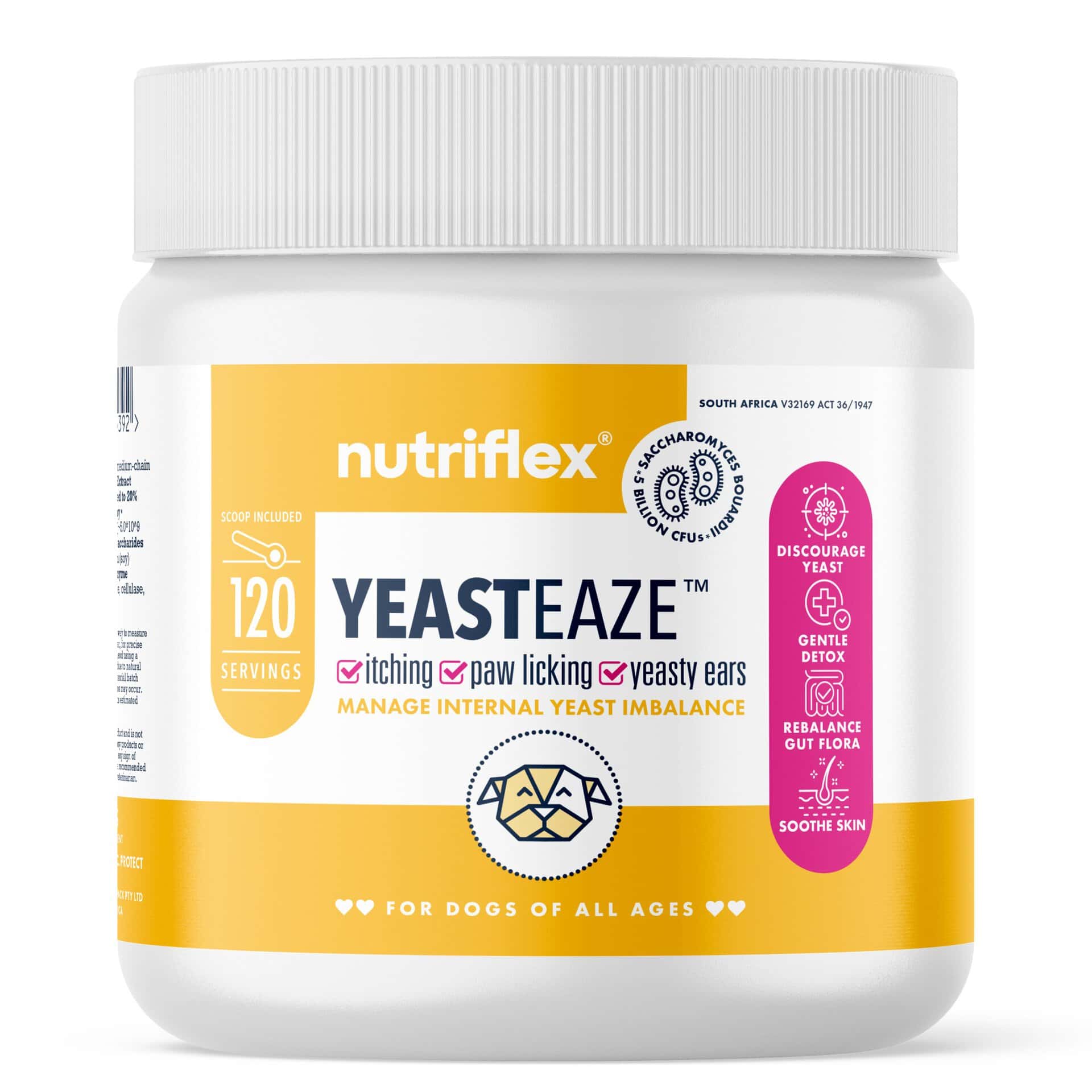
YeastEaze™ for Dogs. Ingestible powder suitable for dogs of all breeds and ages from 12 weeks.
R495,00 – R895,00Price range: R495,00 through R895,00
shopping on nutriflex is safe and secure
In stock and ready to ship
FAST and FREE Delivery R650+
Pickup available: NutriFlex® Factory Shop — Cape Town.
You have tried the shampoos and the special food and it works for a bit and then you are back where you started.
There is a reason for that and it is not your dog and it is not you.
YeastEaze™ is a daily powder for dogs whose skin, ear and paw problems keep returning.
7
Ingredients, each with a mission.
2×
Daily. Sprinkle it on food.
A yeasty ear or a red, licked paw is a real problem, sitting on the surface where you can see it.
Shampoos, wipes and ear drops are built for exactly this and they work.
The yeast lives on healthy skin too. It only turns into trouble when something lets it overgrow.
So the real question is not what is on the skin. It is what keeps letting it bloom.
Treat the surface and the flare settles.
Leave the driver untouched and it comes back.
Same red paws. Same smelly ears. Same cycle.
Clears and stays cleared.
Something underneath keeps re-supplying it.
A one-off surface problem clears and stays cleared. Better, back, better, back means something underneath keeps re-supplying it.
One of the drivers you can actually do something about.
That is also why it is a powder and not a shampoo.
There is no cream for a gut.
If you are reading this, your dog is likely on something from the vet for the constant scratching.
These treatments can provide valuable relief, but they generally work only while they are being used.
Stop them and the itching often returns.
Not because the treatment failed, but because suppressing a signal is not the same as addressing what is driving it.
So the real question is
Why is your dog itching?
It supports the underlying factors associated with recurring yeast-related itching rather than simply quietening the symptom.
Decisions about your dog’s prescription are between you and them.
Drag the handle to compare the picture owners come to us with and where the goal sits.
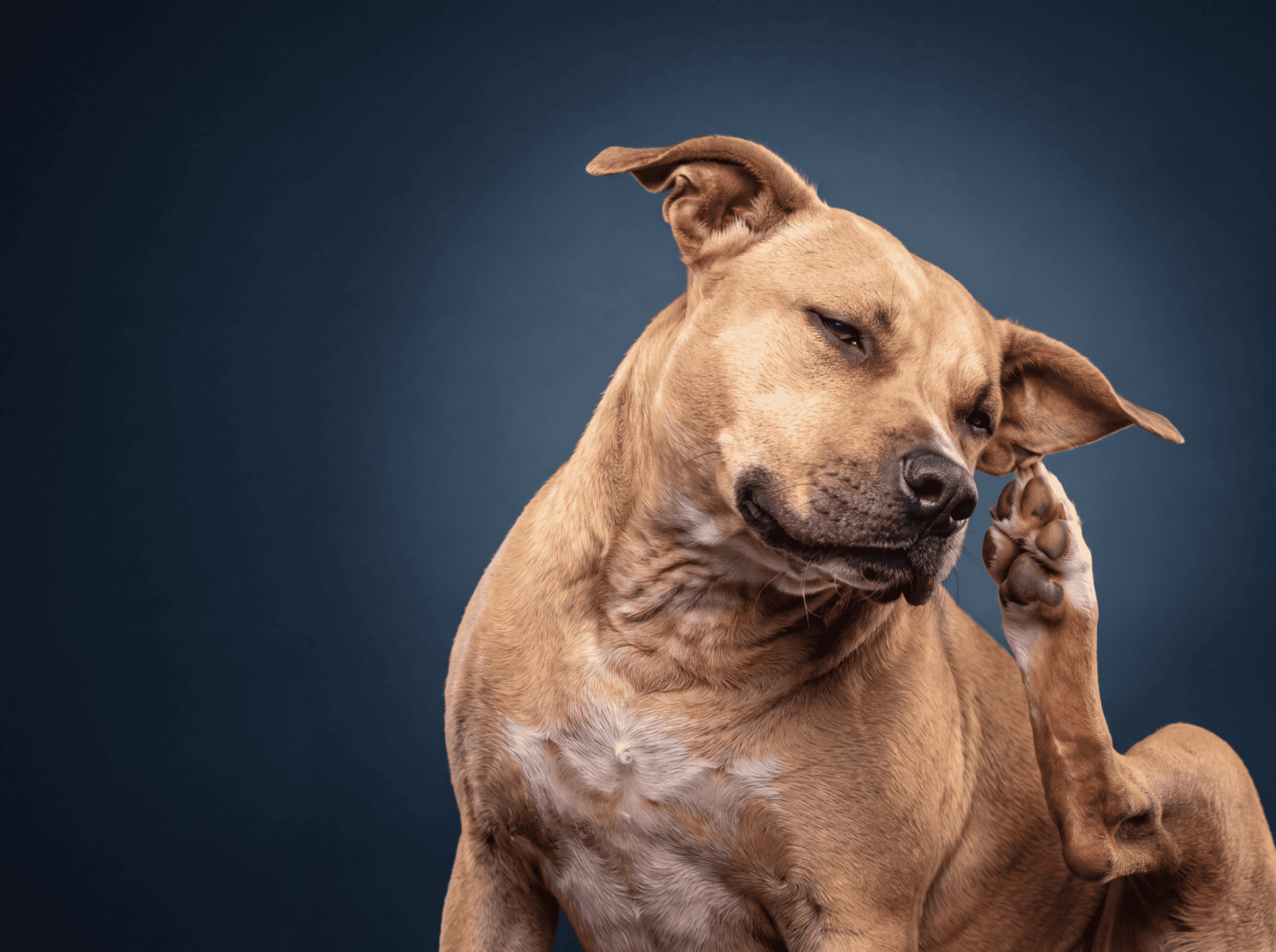
Itchy skin, paw licking, yeasty ears, an unsettled tummy.
After
Before
Calmer skin, a settled tummy, back to themselves.
Illustrative. Individual results vary.
Every ingredient in YeastEaze™ is purpose-dosed for dogs and laser-focused on targeting each specific stage of the yeast cycle. Together, they weaken yeast's defences, cut off what feeds it, help clear what gets released and restore the gut balance that makes recurring flare-ups less likely.
Olive leaf extract, standardised to 20% oleuropein, helps discourage opportunistic yeast and its shift into more aggressive, harder-to-clear forms.
Olive leaf extract · 20% oleuropeinCaprylic acid from MCT helps disrupt yeast cell membranes, causing them to weaken and collapse while creating conditions that are less favourable to overgrowth.
Caprylic acid from MCTFive digestive enzymes help break food down more completely, so less undigested material reaches the lower gut for yeast to feed on.
Five digestive enzymesMOS and β-glucans act as a decoy that pathogens bind to, absorbing free-floating yeast cells so they can be cleared from the gut, while also supporting the immune defences that help keep yeast under control.
MOS & beta-glucansAs yeast recedes it releases the toxins and heavy metals it was holding onto, flooding the gut with unwanted compounds. Bentonite clay helps bind these substances, including excess mycotoxins and endotoxins, so they can leave naturally in the stool, helping reduce nausea, temporary discomfort and other die-off reactions.
Bentonite claySaccharomyces boulardii, a probiotic yeast helps beneficial microbes reclaim the space and resources troublesome yeast wants, while supporting the intestinal barrier and helping maintain a healthier, more stable gut environment, locking in your dog's newfound balance.
Saccharomyces boulardiiLecithin pulls the whole formula together. It binds the oil-based and water-based actives into a single blend the gut can actually absorb and it supports the lining they act on. Without it, even the best formula slips past unused. With it, every other ingredient delivers the job it was chosen for.
LecithinSeven ingredients working together: discouraging yeast, reducing what feeds it, binding what it releases and supporting the gut balance that gives recurring flare-ups less to build on. That is the difference between suppressing a symptom and addressing what drives it.
One root-cause approach to help your dog move from scratchy and uncomfortable to calm, comfortable and balanced.
Most probiotics contain beneficial bacteria.
They can be excellent products, but they are designed mainly to address bacterial imbalance.
Yeast is different. It is not a bacterium, so simply adding more good bacteria may not be enough to bring an overgrowth under control.
The probiotic did not necessarily fail. It may simply have been the wrong tool for the problem.
It competes with unwanted yeasts for attachment sites in the gut, making it harder for organisms such as Candida albicans to:
No. Giving a yeast does not add to the problem.
This matters because antibiotic use can sometimes disrupt the normal gut environment and create the conditions in which unwanted yeast can gain ground.
S. boulardii has been studied in dogs, not only in laboratory models.
University of Bologna · placebo-controlled trialYes. They work differently, so they can be used alongside one another.
Your regular probiotic contains bacteria, while YeastEaze™ contains a beneficial yeast.
2Hours apart
YeastEaze™ also contains bentonite clay, which is included to bind unwanted compounds released as yeast recedes. Giving it separately allows it to do its job without interfering with your probiotic, medication or other supplements.
Keep the same two-hour gap between YeastEaze™ and anything else your dog receives.
Follow this structured 4 to 6 week regimen using YeastEaze™ active yeast flare complex to ensure safe, effective eradication of internal yeast dysbiosis.
Ease your dog onto the powder and get through the first few days.
Some dogs get a little worse before better, itchier or unsettled, usually day two to five. As yeast recedes it releases what it was holding and this stirs things up for a few days. It is the most common reason people stop early. Most dogs pass through it without much fuss.
Steady twice-daily dosing while digestion settles.
What to expectOften the first thing pet parents notice is less gas, less gurgling and firmer stools. Some notice the ears first, or less licking.
Finish the course and let the skin and coat catch up.
What to expectSkin and coat shift here, if they are going to. By the end of four weeks you will know whether it worked.
It probably wasn't yeast. Stop and look at food intolerances, allergies, parasites or a skin condition with your vet. Do not buy a second tub in hope.
You ran the course. The flare has settled and your dog is comfortable. Here is the honest next step.
YeastEaze™ is a course, not a forever product. Once the gut is back in balance, you stop. What keeps a settled gut settled is different work and it is daily.
Two things keep it there.
A daily probiotic with enzyme support keeps digestion steady and the gut flora healthy, so the balance does not drift back. DigestiMax™ does this and it carries a digestive enzyme complex like the one you have been giving.
Omega-3 supports the skin barrier. A stronger barrier means calmer, more comfortable skin, which is what a flare-prone dog needs to keep. OmegaMax™ delivers the EPA and DHA for it.
Together they keep the gut and the skin working with you.
Some dogs get a bit worse before better. Itchier, or unsettled, usually around day two to five. We would rather tell you now than have you find out and stop.
Usually around day two to five
That can stir things up for a few days. It has a name and it is the single most common reason people give up on day three and decide it did not work.
The name Jarisch-Herxheimer reaction The name for a die-off reaction. It describes the short window where clearing yeast out of the gut makes a dog feel briefly worse before they settle.
Two things soften it.
Most dogs get through it without much fuss.
It should only happen once.
Stop and ring your vet.
We are not going to tell you to push through something that worries you.
Both normal.
Some owners notice the ears first, or less licking.
Skin and coat, if they are going to shift.
Nothing at all? Then it probably was not yeast.
Read onGut yeast is hard to confirm. There is no clean test and anything in this category claiming otherwise is overselling.
Stop and go and look at food intolerances, environmental allergies, parasites or a skin condition with your vet.
Do not buy a second tub in hope.
If this sounds like your dog, start the course.
Saccharomyces boulardii ~5 billion CFU minimum
The most-researched ingredient here and the expensive one. A probiotic yeast that competes with troublesome yeast for the same attachment points in the gut. It also releases two compounds, capric acid and 2-phenylethanol and peer-reviewed studies show these interfere with how Candida albicans attaches, spreads and builds the film it hides behind. Bacteria do not do this. It is also unaffected by antibiotics, unusually, so it keeps working through a course.
Olive leaf extract (standardised to 20% oleuropein)
Oleuropein is the compound in olive leaf the research is about. 20% is the highest grade in common commercial supply. Most supplements use 6% and dried olive leaf is naturally about 6% anyway, so a 6% extract has concentrated nothing. Plain "olive leaf" with no percentage could be 1% or 14%, varying by season and cultivar. Ours is measured and the same in every batch. Studied for discouraging opportunistic yeast and for supporting a calmer inflammatory response.
MCT oil powder
Medium-chain triglycerides. Caprylic acid has been studied for its effect on yeast cell membranes. The powder also carries the rest of the formula and makes it taste like something a dog will eat.
Sodium bentonite clay, food-grade
Binds mycotoxins and endotoxins in the gut so they are not absorbed. This is what makes the first week manageable.
Mannan-oligosaccharides (MOS) and beta-glucans
MOS works as a decoy: pathogens attach to it instead of the gut wall and leave with it. It also feeds the good bacteria. Beta-glucans support normal immune function. Research on MOS in dogs specifically found better nutrient digestibility and healthier gut bacteria populations.
Digestive enzyme complex
Amylase, protease, lipase, cellulase and lactase. Yeast feeds on what is not properly digested, so better digestion higher up means less arriving downstream as a free meal. It also cuts the gas, gurgling and loose stools, which are usually the first things owners notice easing. The lactase is deliberate: YeastEaze™ works best in yoghurt and plenty of dogs do not handle dairy. The lactase means the yoghurt goes down without the upset.
Lecithin
Helps the fat-soluble parts disperse and absorb properly. Supports the gut lining.
Identifying an internal yeast imbalance early allows you to intervene before chronic scratching and discomfort take hold. Here’s how to tell if your dog may be dealing with yeast overgrowth and what to do next.
Even after ruling out fleas, food sensitivities, or seasonal allergies, an underlying yeast issue often presents as relentless scratching, especially around the paws, groin, tail base and ears.
Look for intermittent soft stools, occasional gas, or a change in stool odour. These can occur in conjunction with a yeast die-off when the balance of gut flora shifts.
A husky, misshapen coat or reddened, inflamed skin patches can reflect systemic inflammation driven by yeast byproducts.
Dogs with yeast overgrowth often develop a musty or “cheesy” smell on their breath, skin, or coat.
Malassezia and other yeasts thrive in warm, moist environments, so chronically “yeasty” ears may accompany an internal imbalance.
Start with a low dose and increase gradually.
Build up over 7 to 10 daysRapid jumps can trigger die-off reactions and upset your dog.
Stir into your dog’s regular kibble or wet food.
Mix with plain, full-fat yoghurt or bloom with 1 to 2 tablespoons of warm bone broth away from meals.
Feed the formula before their main meal. This gives enzymes a chance to target yeast instead of food.
Ensure your dog eats the full portion. Watch for any mild herx-type reactions (itchiness, soft stools).
Always provide fresh water to aid toxin clearance.
Hold at the last well-tolerated dose for a few days before resuming your build-up schedule.
Recommended daily serving
1 level scoop (2000mg) per 10kg pet weight.
Twice daily, ideally away from food.
NutriFlex® · YeastEaze™
If your dog’s skin turns red and they seem itchier, it could be a Herx effect, an initial response as yeast breakdown releases toxins and any stored heavy metals, temporarily increasing inflammation.
Key points:
If you see redness or inflammation:
Always consult your veterinarian with any concerns; never navigate these changes alone.
No. YeastEaze™ is designed for recovery, not continuous or long-term use. Once your dog’s gut health is restored, please switch to a balanced, nutrient-rich diet to maintain their wellness.
Yeast infections in pets, particularly Malassezia dermatitis, are caused by an overgrowth of naturally occurring yeast on the skin, ears, or digestive tract. While some yeast is normal, certain conditions can tip the balance, allowing it to multiply and trigger infection.
1. Underlying Health Conditions
Pets with weakened immune defences are more prone to yeast overgrowth. Contributing factors include:
In cats, additional risk factors include:
2. Environmental Triggers
Moisture is yeast’s best friend. Triggers include:
3. Poor Grooming Habits
Failure to regularly clean and dry areas such as paws, ears, and skin folds provides yeast with the perfect opportunity to grow unchecked.
4. Genetic Predisposition
Some breeds are naturally more vulnerable.
In dogs, high-risk breeds include:
In cats, the Devon Rex and Sphynx breeds are more frequently affected.
5. Medications That Disrupt Balance
Prolonged use of antibiotics or corticosteroids can upset the natural microbial balance, allowing yeast to overgrow.
6. Diet and Nutrition
Diets rich in refined carbohydrates (like sugars and starches) can “feed” yeast, promoting overgrowth, especially in the gut and possibly leading to systemic issues.
Malassezia dermatitis is a common fungal skin infection caused by the overgrowth of Malassezia pachydermatis, a yeast that is part of the normal skin flora. Clinical signs can vary but are generally distinctive in both species.
1. Skin Changes
2. Pruritus
3. Commonly Affected Areas
4. Odour
5. Hair Loss
6. Paw and Claw Involvement
7. Additional Signs
1. Claw Staining
2. Skin Changes
3. Pruritus
4. Common Concurrent or Associated Conditions
Natural and at-home remedies can be highly effective in managing dog yeast infections, especially when used consistently as part of a whole-dog approach that includes nutrition, hygiene and environmental factors. While veterinary treatments are available, many pet owners seek safer, gentler, and more sustainable alternatives to harsh antifungals or repeated prescriptions.
1. Nutritional Changes
Yeast thrives on sugar and starches, so diet plays a critical role in controlling overgrowth.
2. Paw Soaks & Rinses
Gentle topical treatments can help calm inflammation and reduce surface yeast:
3. Consistent Paw Hygiene
Moisture and buildup are key triggers for yeast, especially between the toes:
Apple Cider Vinegar (ACV)
Tea Tree Oil
Underlying Triggers Matter
Topical remedies can calm symptoms, but long-term relief often depends on addressing root causes like:
Die-Off Reactions ("Herx Effect")
When yeast starts dying off, it can release toxins like gliotoxin and acetaldehyde, leading to temporary symptoms:
To support detox, consider natural binders like:
You don’t always need pharmaceuticals or lab tests to start helping your dog feel better. Many pet parents successfully manage yeast naturally through:
That said, if your dog isn’t improving or symptoms worsen or spread, consulting a trusted integrative or holistic vet can help rule out deeper issues and guide next steps.

Sorry, no reviews match your current selections