
Why Human-Grade Pet Joint Supplements Are Worth Your Attention
Human-grade pet joint supplements are made from ingredients that meet the same safety and quality standards as food made for humans — not just the lower “feed-grade” bar set for most pet products.
Here’s a quick summary of what matters most:
- What “human-grade” means: Every ingredient must be safe and fit for human consumption, made in facilities that meet human food standards
- Key ingredients to look for: Glucosamine, chondroitin, MSM, omega-3s (EPA + DHA), collagen, and hyaluronic acid
- Best formats: Liquid drops, soft chews, supplement bars, or food toppers — each with different absorption rates
- Who benefits most: Senior dogs, large breeds, and any dog showing signs of stiffness, limping, or reduced activity
- Does it replace medication? No — but it can be a powerful part of a multimodal care plan alongside vet guidance
One in four dogs in the United States suffers from some form of arthritis. Among senior dogs, that number climbs to as high as 80%. Yet most pet owners only notice the problem when their dog is already struggling to climb stairs or get up after rest.
The gap between noticing a problem and acting early is where joint health really matters.
That’s why more pet parents are turning to human-grade joint supplements — products held to a higher standard, made with cleaner ingredients, and designed to actually be absorbed and used by your dog’s body.
This guide breaks down what to look for, what the science says, and how to choose the right option for your dog.
What Defines a Human Grade Pet Joint Supplement?
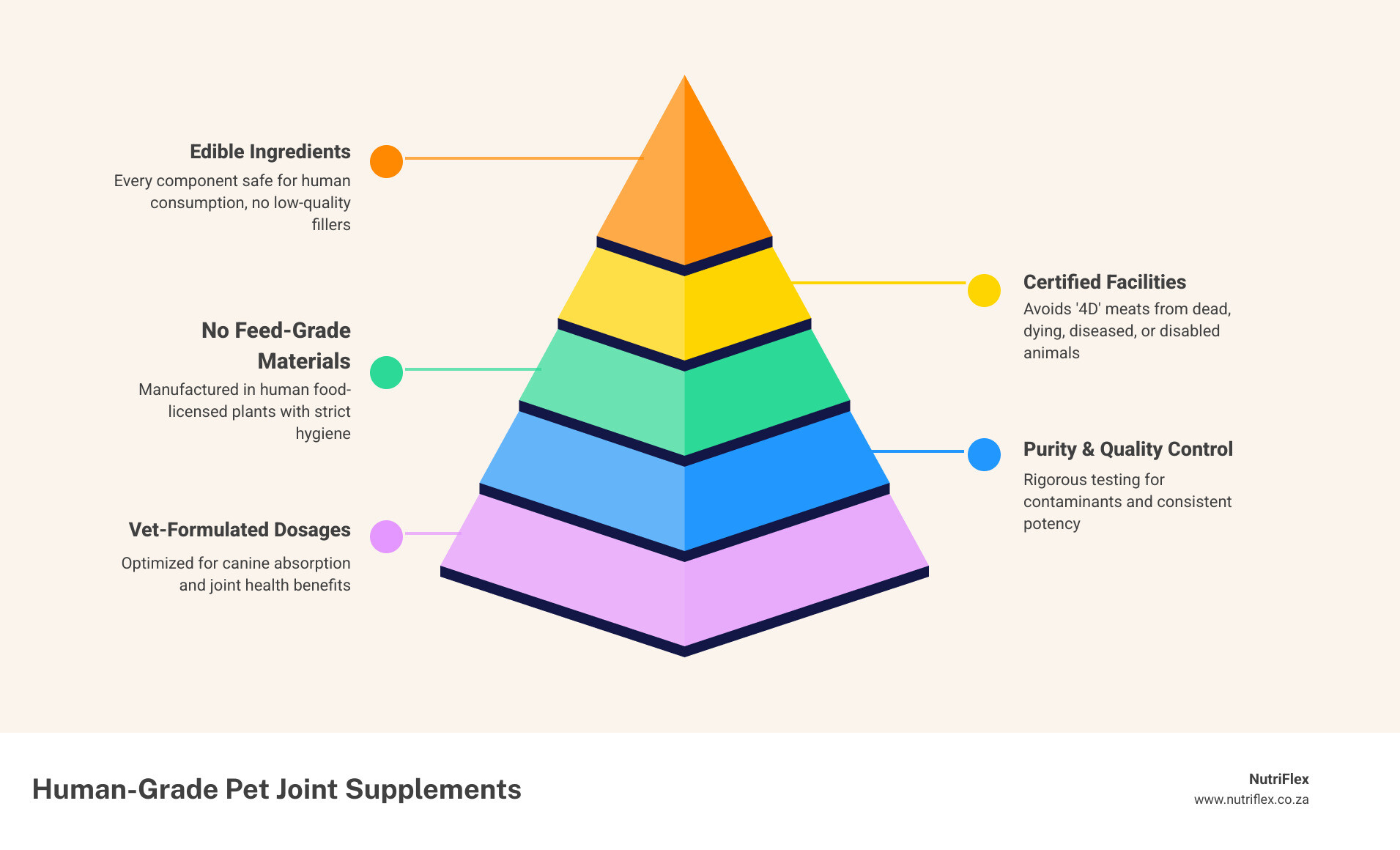
When we talk about a human grade pet joint supplement, we aren’t just using a fancy marketing buzzword. In pet nutrition, “human-grade” has a very specific legal and structural meaning. To carry this label, a product must be made with ingredients that are legally classified as “edible” for humans. This means every single component, from the active glucosamine to the inactive binders, must meet the safety standards set for the food you find in your own pantry.
Furthermore, these supplements must be manufactured in facilities that are licensed to produce human food. This is a massive jump in quality compared to “feed-grade” products. Feed-grade items are often processed in plants that handle “4D” materials—meats derived from animals that were dead, dying, diseased, or disabled before reaching the slaughterhouse. By choosing human-grade, you are effectively ensuring that your dog is eating at the same “table” as you are, with all the hygiene and purity that entails.
| Feature | Human-Grade Standards | Mass-Market (Feed-Grade) Standards |
|---|---|---|
| Ingredient Quality | 100% fit for human consumption | May include “4D” meats and by-products |
| Facility Certification | Licensed human food facility (e.g., SQF or GMP) | Animal feed processing plants |
| Fillers & Synthetics | Minimal to none; focus on whole-food purity | Often contains synthetic binders and preservatives |
| Safety Testing | Rigorous third-party testing for pathogens | Less frequent, baseline regulatory checks |
Understanding more info about dog joint care starts with recognizing that the quality of the raw material dictates the results you see in your dog’s mobility. If the ingredients are poor quality or heat-damaged during low-standard manufacturing, their biological activity—and thus their ability to help your dog—is significantly diminished.
Essential Ingredients for Maximum Bioavailability
Bioavailability is the “secret sauce” of any effective joint support. It refers to how much of an ingredient actually makes it into your dog’s bloodstream and reaches the joints. A supplement can claim to have massive amounts of glucosamine, but if it’s in a form the dog can’t absorb, it’s just expensive waste.
The Powerhouse Trio: Glucosamine, Chondroitin, and MSM
These three are the bedrock of joint health. Glucosamine is an amino sugar that acts as a building block for ligaments, tendons, and the fluid surrounding the joints. It helps suppress inflammation and can even boost the repair of damaged cartilage.
Chondroitin sulfate works synergistically with glucosamine. While glucosamine builds, chondroitin protects by inhibiting the enzymes that break down cartilage. We often look for sources like New Zealand green-lipped mussel, which provides a natural, highly bioavailable form of these compounds. MSM (Methylsulfonylmethane) is the third pillar, acting as a powerful natural anti-inflammatory that helps reduce the pain signals in arthritic joints.
The Modern Frontier: Type II Collagen and Eggshell Membrane
Traditional supplements often stop at the trio above, but we believe in pushing further. More info about Type II Collagen reveals its role in “oral tolerance.” This specific type of collagen, often derived from chicken sternum, helps train the immune system to stop attacking its own joint cartilage.
Eggshell membrane (ESM) is another ingredient. This thin layer between the egg and the shell is naturally packed with collagen, glucosamine, chondroitin, and elastin. A study on eggshell membrane efficacy in dogs showed that daily administration could significantly improve joint functionality and reduce pain in dogs with hip dysplasia.
Lubrication and Inflammation: Hyaluronic Acid and Omega-3s
- Hyaluronic Acid (HA): Think of HA as the “oil” in your dog’s joint “engine.” It increases the viscosity of the synovial fluid, ensuring smooth, frictionless movement.
- Omega-3 Fatty Acids (EPA & DHA): These are essential for managing the systemic inflammation that drives joint degradation. We prefer sustainable krill meal because the Omega-3s are bound to phospholipids, making them far easier for a dog’s body to absorb than standard fish oils.
- Astaxanthin: Found in krill, this is one of the most potent antioxidants on Earth. It helps neutralize the oxidative stress that occurs in inflamed joints.
- Turmeric: This golden spice contains curcumin, which has been used for centuries to manage pain and swelling naturally.
Choosing the Right Human Grade Pet Joint Support for Your Dog

Every dog is an individual, and their joint needs change based on their “stats”—age, breed, and weight.
Breed Predispositions and Large Breeds
If you share your home with a Great Dane, a German Shepherd, or a Labrador, joint care isn’t just a “nice to have”—it’s a necessity. Large and giant breeds carry more weight, which puts constant mechanical stress on their skeletal system. These breeds are also genetically predisposed to conditions like hip and elbow dysplasia. Starting a human grade pet joint regimen early (often around one year of age) can help maintain the integrity of the cartilage before visible damage occurs.
Senior Dogs and Early Warning Signs
As dogs age, the natural production of joint-lubricating compounds slows down. Identifying the signs of early joint problems in dogs is crucial. Look for:
- Hesitation before jumping into the car or onto the sofa.
- “Bunny hopping” when running.
- Stiffness that seems to “warm up” after a few minutes of walking.
- Licking at specific joints.
The Weight Factor
We cannot talk about joints without talking about the scale. There is a direct research on obesity and canine osteoarthritis link. Excess fat isn’t just “dead weight”; it’s metabolically active tissue that pumps out pro-inflammatory cytokines. This creates a “double whammy” for joints: more weight to carry and more inflammation to endure. Keeping your dog at a lean body condition score is the single most effective thing you can do alongside supplementation.
Optimal Dosages for human grade pet joint Health
When reading a label, don’t just look for the ingredient names—look for the concentrations. A high-quality supplement should provide transparency. For example, some premium formulations provide:
- Glucosamine: 1200mg to 1800mg per serving for larger dogs.
- Chondroitin Sulfate: Roughly 800mg to 1000mg.
- Omega-3s: A minimum of 1.60% total fatty acids, with specific levels of EPA (0.65%) and DHA (0.65%).
Checking the active ingredients in joint supplement for dogs ensures your dog is getting a therapeutic dose rather than a “window-dressed” amount that looks good on the label but does little for the dog.
Administration, Dosing, and Veterinary Perspectives
How you give the supplement matters almost as much as what’s in it.
- Liquid Drops: These often offer the highest bioavailability because they don’t require the body to break down a dense chew or pill. They can be easily mixed into food.
- Soft Chews and Bars: These are the most convenient and act as a “healthy treat.” However, ensure they are cold-pressed. High-heat processing used in many mass-market kibbles and treats can denature the very proteins (like collagen) you’re trying to provide.
- Powder Toppers: These are excellent for consistency, as they can be sprinkled directly onto meals.
Why it pays to be consistent with joint care cannot be overstated. Joint supplements are nutraceuticals, not pharmaceuticals. They don’t work like an aspirin that provides relief in 30 minutes. Instead, they build up in the system over 4 to 8 weeks. Skipping doses means the “building blocks” aren’t consistently available for tissue repair.
Can a human grade pet joint Supplement Replace Prescription Meds?
This is a question we hear often. For dogs with severe, chronic osteoarthritis, a natural supplement for dog arthritis is usually part of a multimodal therapy. This means it works alongside things like weight management, physical therapy, and sometimes prescription NSAIDs (Non-Steroidal Anti-Inflammatory Drugs).
The benefit of human-grade supplements is that they are safe for long-term use. While NSAIDs are excellent for acute pain, long-term use can sometimes lead to kidney or GI issues. By using a high-quality joint support product, many owners find they can eventually reduce the dosage of prescription medications (under veterinary supervision), providing a safer long-term management strategy.
Frequently Asked Questions
Are there risks or limitations to human-grade ingredients?
Human-grade ingredients are generally much safer because they lack the contaminants found in feed-grade products. However, the main “risk” is usually related to allergies. For instance, if your dog has a severe shellfish allergy, you should avoid glucosamine sourced from shrimp or crab shells and look for vegan or bovine-sourced alternatives. Always introduce any new supplement slowly to ensure it doesn’t upset your dog’s stomach.
What nutritional analysis should I look for on the label?
A reputable human grade pet joint product will provide a “Guaranteed Analysis.” Look for:
- Crude Protein and Fat percentages.
- Specific milligram counts for Glucosamine, Chondroitin, and MSM.
- Levels of EPA and DHA.
- A seal of approval from a recognized body or evidence of third-party testing.
How do I properly dose a joint supplement based on dog size?
Most human-grade supplements use weight-based dosing. A common mistake is “under-dosing” large dogs to save money. If the label says your 40kg dog needs two scoops, giving them one scoop won’t just provide “half the benefit”—it may provide no benefit if the concentration in the blood doesn’t reach a therapeutic threshold. Always follow the manufacturer’s guidelines, and when in doubt, consult your vet.
Conclusion
At NutriFlex, we believe that our pets deserve the same quality of nutrition that we demand for ourselves. That’s why we’ve committed to producing premium, vet-approved supplements right here in our Cape Town facilities. By using 100% pure, certified human-grade ingredients with no synthetics or “mystery” fillers, we ensure that your dog is getting the most bioavailable support possible.
Whether you have a young pup you want to protect for the future or a senior dog who deserves a more comfortable retirement, the right joint support can make all the difference. From the initial “loading phase” to long-term maintenance, choosing a human grade pet joint support system is an investment in your dog’s quality of life.
Ready to see your dog move with more ease? Shop human-grade joint supplements today and give your best friend the support they need to keep wagging, running, and playing for years to come.
